Tooro Kingdom: Where Gaddafi still rules
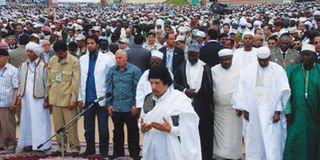
Col Muammar Gadaffi leads Muslims in prayers to mark Prophet Muhammad’s birthday at Nakivubo stadium on May 18, 2008: A year ago, rebels killed the Libyan strongman whose legacy in Uganda includes mosques and the propping up of monarchs. Photo/STEVEN WANDERA
What you need to know:
- Unbroken ties: Former Libyan leader Muammar Gaddafi was always warmhearted towards this Ugandan kingdom. That explains why, when civil unrest broke out in Libya last year, Queen Mother Best Kemigisha pleaded with other African leaders to save Gaddaffi from the rebels. An official now says the honour given to Gaddafi in recognition of his contribution to the Tooro Kingdom will never be revoked
The images beamed to the world from the Libyan town of Sirte on October 20 last year were as horrific as they were grossly nauseating.
Former Libyan ruler Muammar Gaddaffi, who had survived a rebellion for almost a year, had finally been cornered by the armed wing of his opposition, the National Transitional Council, huddled in a culvert, terrified and waiting for the worst.
The worst did indeed happen, as the bloodied face of the ruler, which was beamed to the world, attested.


The man who had ruled Libya for nearly 41 years had been captured alive, but many say he was dead or critically injured within minutes.
Victory whoops followed his death throughout Libya and much of the world, which underpins the reality that the iron man may never be branded a hero or fondly remembered in many parts of the world.
But in the western Ugandan Kingdom of Tooro, Col Gaddaffi remains a treasured and respected statesman, an African leader who, even in death, is considered “a defender of the Kingdom”.
And it is easy to see why; the kingdom is ruled by a young monarch — King Oyo Nyimba Iguru Kabamba Rukidi IV — who grew up under Gaddafi’s patronage.
Inside the imposing Tooro palace atop Kabarole Hill, American journalist Andrew Green, who has been granted access, says a portrait of Gaddafi still dominates the reception.
Hung opposite the throne, it is an image of the Libyan leader in a triumphant pose, his fist raised to proclaim his power.
The image dwarfs the room’s other adornments: photographs of unsmiling former Toro kings, overstuffed furniture, and animal skins.
“The royal family is going to miss him quite a lot,” Phillip Winyi, the Kingdom’s foreign relations minister, told the Foreign Policy Magazine in June. The Gaddafis “were like another family” to them.
However, although Gaddafi is still revered in the Kingdom, some people in January removed his portrait from the palace and a plaque on one of the premises. The plaque, fixed on the Karuzika palace wall in Fort Portal in 2001, was inscribed with the words: “This foundation stone was laid by the Great Leader of the Revolutionary Socialist Libyan Arab People’s Jamahiriya, H E Col Muammar-Al-Gaddafi, on 14th JULY 2001.”
The relationship between the kingdom and the former Libyan leader started in 2000, when President Museveni introduced King Oyo during celebrations to mark Uganda’s Independence at Kololo on October 9 that year.
It is said Gaddafi was awestruck by the then nine-year-old king festooned in his regalia. He admired how the Batooro respected and treasured such a young leader.
Namara Arthur Araali, the Kingdom’s Minister of Information, says Gaddafi immediately invited King Oyo to Libya in early 2001.
In July of the same year, Gaddafi made his maiden visit to the kingdom, attracting so much pomp and security that, Oyo’s subjects recall, it was like “heaven coming to meet the earth”.
At time of the visit, the biggest project in the kingdom was the renovation of Karuzika (the palace), and Gaddafi, in his trademark exhibition of magnanimity, offered to fund the works.
The palace had been destroyed by Idi Amin’s soldiers, who had used it as their barracks in the 1970s.
The relationship between Gaddafi and the young King and his family blossomed. The Libyan ruler even offered to pay for the King’s sister’s education, and to build a hospital and a school for Oyo’s subjects.
A plaque was affixed at the entrance to the palace, honouring the “great leader”, and the residents of Fort Portal took soon renamed the structure, either in jest or awe, “Gaddafi’s Palace”.
In turn, Gaddafi was bestowed by King Oyo with the title ‘Omujwara Kondo’ (Defender of the Kingdom), which is the highest honour in Tooro.
The only other outsider to receive the honour is President Museveni — for restoring kingdoms in 1993.
Since the founding of Tooro Kingdom in 1830, no other person had been given the honour.
“Tooro Kingdom was (Gaddafi’s) darling institution,” the magazine quotes Winyi as saying.
“Whatever he wanted done, he would use Tooro Kingdom to do it.” And indeed Gaddafi found the kingdom useful in his forays to East Africa.
He, for instance, used Tooro officials to help organise a meeting between him and other cultural leaders in Uganda and from across the East African region in Benghazi.
However, this move put the kingdom at loggerheads with the government. Although the organisers said the August 2008 conference was aimed at discussing the role of traditional rulers in modern Africa, political players saw this as Gaddafi’s plan to use the group to press African leaders who had rejected his call for a United Africa.
President Museveni, who had opposed Gaddafi’s call for a United States of Africa, saw the Tooro Kingdom’s championing of the African kings and sultans conference as a deviation from the purely cultural role that was agreed upon before its restoration.
The National Assembly was quickly looped in and a resolution was passed that all travel requests by the traditional leader must be made through the Ministry of Foreign Affairs.
Because of these restrictions, neither the Benghazi nor the Kampala conference took place.
But in a 2008 forum with the kings, they gave Gaddafi the title “King of Kings”. The move might have annoyed the government, but it did not stop the love that had blossomed between the Tooro royals and Gaddafi.
The royalty and Oyo’s subjects closely followed the developments in Libya in 2011, and Queen Mother Kemigisa, who was the secretary general of the Forum for African Traditional Leaders, in an interview with Uganda’s Sunday Vision once described Gaddafi as a revolutionary and Pan-African leader who had done a lot to develop the continent.
She also appealed to other African heads of state to support Gaddafi in the war against the rebels. No one took heed, and Gaddafi ended up dead.
A year on, Tooro still feels the loss of “a dear friend and financier”. “The kingdom lost greatly,” says Joseph Mashubuku, a councillor in Kabarole. “There are things we shall always remember Gaddafi for, such as the renovation of the palace and other contributions. We were still expecting much from him,”
“Gaddafi had wanted to put up a school and a hospital here but, since his death, everything has stalled,” adds Moses Aliganyira, a businessman in Kyenjojo.
But while some subjects still mourn the loss, others feel it was only the royal family that benefited from the ties with Tripoli.
“The Kingdom of Tooro is for the few people who benefit; that is, the Queen Mother and her family. The death of Gaddafi is a loss to the royal family, not the Batooro,” Lillian Kanyunyuzi, a businesswoman in Fort Portal, says.
The people of Kabarole are, however, divided on the fate of Gaddafi’s son, Al-Islam, who is in custody awaiting trial.
While some call for his execution for alleged crimes against humanity during his father’s rule, others say the new Libyan government should pardon him.
“As Muslims, we believe in forgiveness. The son should be forgiven as he was misled,” says Kadra Rujumba, a resident of Fort Portal.