Is this man Africa’s only hope for justice?
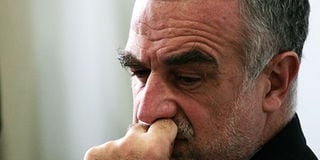
Anti-impunity czar: The ICC chief prosecutor directed an investigation against Germain Katanga and Matthieu Ngudjolo Chui, who received arrest warrants in 2007 and 2008 respectively for crimes against humanity in the Democratic Republic of Congo. He has been a constant thorn in the flesh for the masterminds of the 2007 post-election violence in Kenya, and his bombshell last week that he plans to release the names of the suspected planners and financiers of the mayhem is the best proof yet that he means business.
What you need to know:
- Luis Moreno-Ocampo’s forays into the darkest corners of Africa have attracted the fury of the continent’s despots, but his integrity train rolls on
The announcement last week by International Criminal Court (ICC) prosecutor Luis Moreno-Ocampo that he intends to make public the names of the suspected masterminds of the 2007 post-election violence has sent the country into a spin.
Scenes of chest-thumping bravado and accusations across the political divide, triggered by the rather unpalatable prospect of losing political kingpins to The Hague, are now the order of the day. But Mr Moreno-Ocampo insists that there is no turning back, and that no amount of political gimmickry will derail his mega-tonne justice train.
To those unlucky or unruly enough to be in his gun sights, the Argentine is a constant source of dread and sleepless nights. But for the masses affected by the post-electoral turmoil, Mr Moreno-Ocampo is a saviour, a man in whose hands they believe they can safely keep their hopes for justice.
Attempt to condemn


Little wonder, then, that there has been a spirited attempt by many suspected villains across the continent to condemn and label the ICC and its erstwhile prosecutor as enemies of Africa’s style of governance and justice.
During the ICC Review Conference held in Kampala in June this year, accusations against the court by various delegations raised eyebrows around the world, with some even calling its processes “anti-Africa”. Rwanda President Paul Kagame, one of the strongest opponents of the court, once termed the ICC a “vehicle of neo-colonialism, slavery, and imperialism”.
Weak judicial systems
The 2006 dismissal of potential cases against US actions in Iraq and the apparent inaction by the ICC on situations in other hotspots outside Africa have also been cited by those accusing the court of applying selective justice. International law experts, however, cite weaknesses in Africa’s legal systems as the major cause of the big number of situations being referred to the ICC.
Which is why many in civil society lobby groups, the media, and a large section of the general public have welcomed the growing number of referrals to The Hague as a sign of the continent’s commitment to international criminal justice and a desire to weed out the strangling culture of impunity.
Established in 2002 through the Rome Statute as a permanent tribunal to prosecute individuals for genocide, crimes against humanity, and war crimes, the ICC is the last resort for many, even though its authority ranks below that of national courts. This means proceedings are initiated through referrals by a state party, the prosecutor, or the UN Security Council.
As of March 2010, 30 African countries had acceded to the Rome Statute, although only a handful had amended their domestic laws to accommodate its provisions.
A strong pointer to the weaknesses of Africa’s judicial systems — or its love for the machete — is that most of the situations the court has been investigating since its inception concern conflicts in northern Uganda, The Democratic Republic of Congo, Sudan, and the Central African Republic. Of the ICC’s 15 warrants of arrest issued, 11 are for individuals from Africa.
Suspects in custody at The Hague are former DR Congo warlords Thomas Lubanga, Germaine Katanga, Mathew Chui, and Jean-Pierre Bemba, and former Liberian strongman Charles Taylor. Other wanted suspects still at large include Sudan leader Omar al-Bashir and his humanitarian affairs minister Ahmad Harun, Janjaweed militia commander Muhammad Rahman, the Lord’s Resistance Army’s (LRA) Joseph Kony, and four of his senior deputies.
The perceived failure by the court to investigate corporate entities accused of fuelling conflict in Africa is one of the issues that many opponents of the court have cited in their allegations of selective justice.
A UN report released in October 2002 accused 85 companies of supplying arms to the Ugandan and Rwandan armies and 25 militia groups in DR Congo. Although the ICC was quick to issue warrants of arrest against Congolese and LRA warlords, critics say it has done or said nothing against these firms, most of them still operating in the Great Lakes region.
“If those indicted have committed any crime, surely they must face the consequences of their actions,” says Lord Aikins Adusei, a West African political commentator.“But it will also be an incomplete justice if those supplying the weapons and bankrolling the conflicts are allowed to go unpunished.”
There are also claims that the fact that major world powers are not bound by the Rome Statute considerably dents the authority of the ICC to act as an impartial centre for justice.
The US, China, and Russia, all permanent members of the UN Security Council, are not signatories, which makes the court toothless in situations where the three are involved. This is evident in the lacklustre approach to situations in the Middle East and Asia, where each member of the council has vested interests.
Hague Invasion Act
To protect its soldiers against any future action by the court, the US Congress passed the American Servicemembers Protection Act (ASPA) in 2002. Dubbed the “Hague Invasion Act” by opponents, the legislation not only prohibits any form of military aid to countries that have ratified the statute (exceptions granted), but also empowers the US president to use military force to free American soldiers held by the ICC.
To further advance what human rights activists have termed a “two-tier system of international justice”, the world’s biggest democracy has been coercing nations to sign the controversial Bilateral Immunity Agreements (BIAs), which bar signatories from surrendering American nationals who have committed major crimes to The Hague.
Although President Obama has removed the sanctions to the BIAs, his administration is yet to formalise a policy decision on either the ICC or the bilateral agreements.
The few African nations — like Kenya and Malawi — that refused to sign the repressive BIAs were penalised by drastic cuts or withdrawal of military funding. Reports indicate that around 100 countries, mostly economically vulnerable Third World nations, are party to these agreements.
But, apart from lifting the BIA sanctions, the current American administration has softened the country’s stance on the ICC by sending delegations to the court’s annual meeting of the Assembly of States Parties in The Hague in 2009 and the Review Conference in Kampala earlier this year. And, on both occasions, US representatives expressed their country’s desire to cooperate with the court.
“After 12 years, I think we have reset the default on the US relationship with the court from hostility to positive engagement,” said State Department Legal Adviser Harold Koh of the future of US-ICC relations in light of the Kampala Review Conference. “In this case, principled engagement worked to protect our interest, to improve the outcome, and to bring us renewed international goodwill.”
In a move that might significantly shift the paradigms of international justice, member states at the ICC Review Conference in Kampala agreed to add the crime of aggression to the list of the court’s prosecutable offences. Expected to come into force in 2017, the amendment will give the prosecutor or a state party the authority to initiate an aggression case where the UN Security Council fails to take action.
Probably piqued by politicians’ claims that The Hague’s actions may destabilise regions, Mr Moreno-Ocampo has, on numerous occasions, emphasised that his investigations follow legal rather than political possibilities. And he repeated this assurance during the National Dialogue and Reconciliation Conference in Nairobi last week, saying he was not interest in the cause of the Kenyan violence, but the alleged perpetrators.
This tricky balancing act, made worse by wily politicians and their supporters, points to the winding path through which Mr Moreno-Ocampo and his team must manoeuvre to rid their court of any iota of susceptibility to politicisation.
In Kampala last June, for example, the sharply divided Kenyan delegation clearly manifested the ODM-PNU coalition rifts in plenary sessions, where they differed on almost every issue despite being presumed to represent the collective position of the nation over the ICC.
Investigate Museveni
During the same gathering, a Ugandan opposition leader called on the ICC to investigate the country’s president, Yoweri Museveni. While presenting his evidence to the prosecutor, Mr Olara Otunnu, head of Uganda Peoples Congress Party, said President Museveni should be investigated for crimes committed in Kampala, northern Uganda, and the DR Congo.
This came even as the Lord’s Resistance Army leader Kony refused to negotiate any peace deal until the warrants against him and four of his top aides are dropped. But the LRA might be headed for the gallows if a recent plan by President Obama to disarm the group materialises.
However, for many, it was the ICC’s warrant of arrest against Sudan President Omar al-Bashir a year ago that proved it had the guts to go after the “big fish”. Charged with genocide, war crimes, and crimes against humanity in Darfur, al-Bashir made history by becoming the first sitting head of state to be indicted by the ICC.
But the African Union reacted swiftly by convening a gathering in Libya, where members voted against the directive, with Senegal calling on all African countries to withdraw their ICC membership en masse as a sign of protest. The request was not granted, and, instead, several African countries have since declared their will to implement the arrest warrant.
Although the Sudan leader has dismissed the indictment as the antics of a “white man’s court” designed to destabilise Africa, the dragnet is rapidly closing in on him. And, although countries like Kenya and Libya have allowed the wanted head of state within their borders, he has already been excluded from the Olympics in Beijing, the World Cup in South Africa, and the African Union heads of states summit in Kampala.
Before making the bold move against the Sudanese supremo, Mr Moreno-Ocampo had been criticised by human rights groups for his cautious approach to states like Rwanda and Uganda.
Friendly countries
But after the move, Mr Antonio Cassese, a former president of the International Criminal Tribunal for the former Yugoslavia who chaired the United Nations Commission of Inquiry on Darfur, criticised Mr Moreno-Ocampo for charging al-Bashir with genocide and issuing a public warrant of arrest. This, Mr Cassese argued, made it easy for the Sudanese leader to avoid arrest by travelling only to friendly countries.
“If Moreno-Ocampo intended to pursue the goal of having al-Bashir arrested, he might have issued a sealed request and asked the ICC’s judges to issue a sealed arrest warrant, to be made public only once al-Bashir travelled abroad,” Mr Cassese wrote in an article published by SudaneseOnline.com in July 2005.
But, to many, that does not matter. What matters is that the wheels of justice have begun to turn, no matter how slowly. And no one could sum that hope better than the prosecutor general of Rwanda, Mr Martin Ngogo.
“There is not a single case at the ICC that does not deserve to be there. But there are many cases that belong there, that aren’t there.”