With Karl Marx, all tried and failed
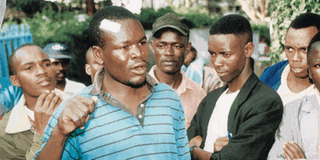
Christopher Owiro (with bandage) in his student activism heyday. Photo/FILE
What you need to know:
- In his heyday, Christopher Owiro, famously known as Karl Marx, was a man on demand. The ladies wanted him (they said he was the toughest man around), and politicians coveted his hand even more. Those who sought to exploit his mass mobilisation prowess paid sweetly to have him by their side, while those who loathed him did it with religious conviction. Former President Daniel Moi was proudly among the latter, and he wondered loudly why the police commissioner could not contain this mere university boy. Karl Marx was a messiah to some, and the devil incarnate to many more others
Dark, unrefined, with a missing tooth here and there and piss drunk most of the time, Karl Marx could pass for just another rowdy boy on the alleyways of the University of Nairobi.
But his deep convictions about life, his philosophical thoughts, his unwavering spirit and the way he married words with wit of the garb made him perhaps the most powerful student leader of his time.
Fwamba C Fwamba, his former campus mate, says Karl Marx was such an inspiration to many young people of his age that the Moi regime became uncomfortable with his antics.


He was a peoples’ man, a man of his word, a great community mobiliser who towered way above his student title.
“When you listened to him, you felt touched and moved by his words,” recalls lawyer Irungu Kang’ata, who was inspired by Karl Marx’s activism when in First Year class to join student politics, vying — and winning — the giant Students Organisation of Nairobi University (Sonu) vice chairmanship.
These two agree that the man was a paradox. Whereas he dined with the rich and mighty, he loved the poor, mostly his fellow students, some of whom he time and again rescued from social joints in town whenever they failed to pay for their froth.
And whereas at times he violently and illegally imposed curfews within campus halls so as “to curb rising immorality”, he also stood guard, some say, as male students forced their girlfriends into sexual submission. Karl Marx himself was once accused of sexually assaulting a female student.
He harboured presidential ambitions but failed to win the votes in Sonu. Critics have argued that his greatest absurdity was preaching progress socially, economically and politically, when he himself was a social wreck.
When he died last week, Karl Marx had already fallen to alcoholism and disillusionment. He was disorderly and drunk most of the time. Many had tried to rehabilitate him... and failed.
When the real Karl Marx, that famous 19th century German revolutionary thinker, remarked that “history repeats itself, first as tragedy, second as revolution”, he might as well as have been referring to the student leader who, many years later, would adopt his name.
Many of those who had heard heroic tales about the man were easily disappointed when, eventually, they met him. About two months before his death, for instance, former Kenyatta University Students Association (Kusa) academic secretary Nandalwe Wanjala, who was then a personal assistant to Cotu boss Francis Atwoli, had to make several calls to confirm whether the man who had visited the trade union’s offices was indeed the highly regarded Karl Marx.
“If he appears shaggy or drunk, it must be him,” a former Sonu chair told Wanjala. And indeed poor Marx had staggered into Cotu smelling like a brewery.
However, those who knew him were so used to him being like that, right from his campus days, when he plunged head-first into student and national politics when just a mere First Year student.
Karl Marx pushed for student rights by all means necessary. He broke into student rooms using an axe to force sleeping ‘comrades’ to join him on the streets, spent several days in cold police cells, was roughed up and beaten by opponents and the dreaded General Service Unit (GSU), and yet the stoic character never gave up.
He pushed for the conversion of Stella Awinja Guest House to a hostel, argued the case of students with fees arrears to sit their exams and pay the amounts later (he was himself from a poor family), and bought satellite TV decoders for students’ halls of residence, then an expensive commodity regarded to be only for the rich.
He believed that every issue had a mathematical solution and took great pains to systematically illustrate how the Kanu and LDP merger would not last for long and how the parallel degree programme was to eventually turn university education into a sham.
He once forced VC Prof Francis Gichaga through a calculus session, explaining to him why the parallel degree programme would lower the standards of university education. Time has proven him right.
On weekends, he held morning briefings at 10am outside Hall 10 with students where he answered their questions with wit, humour and rare intellectualism.
Karl Marx was a master strategist, chief propagandist and gifted orator who once told Prof Gichaga that his ultimate punishment for refusing to let him have his way was to marry the VC’s daughter.
His colleagues at the university fondly remember him for the way he and others led the fight for the revival of Sonu. But, even though students trusted that through his radicalism he could force the university administration to remove the ban on Sonu, they never trusted him with its leadership.
He issued threats to the university administration in the tone of a Marxist revolutionary.
Together with others, he renamed the revived Sonu, SONU98, but unsuccessfully vied for a leadership position for three years. During student elections, he loved the phrase “we win they loose or they loose and we win”. But every time he lost, be blamed it on rigged elections.
In a blog, his former coursemate and close friend Kenyatta Otieno says of Marx: “Even without a formal position in the student government, he was a force you couldn’t just wish away.”
When it came to haki ya mwananchi, Karl Marx stood on the right side of history. He was on the leading front during the Muungano wa Mageuzi rallies where he shared the podium with the likes of Shem Ochuodho, James Orengo and the late Enock Magara.
When one day he bought peas from a supermarket and discovered that they had stones, he carried them in a cooking sufuria back to the supermarket, forcing its closure for hours.
Karl Max was the self-declared head of a campus vigilante group identified as UoN’s Military Wing, alias Kosovo. He claimed to have fought alongside the late John Garang in the Sudan Peoples Liberation Movement (SPLM).
Kosovo was responsible for various atrocities, including beating political opponents, forcing female students to take back their rejected boyfriends and working hard to make the university “ungovernable”.
Always in a hurry and full of energy, Karl Marx seemed to attract trouble everywhere he went and his abrasive style earned him countless beatings, including an incidence when he lost his teeth when he tried to disrupt a First Years’ party at Parklands Law Campus.
Opposed to the Kanu/LDP merger, some delegates for the National Convention Executive Council (NCEC) conference that was to be held in Kisumu had to turn back after they were informed that Karl Marx and a platoon of his ‘soldiers’ would frisk and steal their valuables, and lash them with 10 hard strokes of the feared nyaunyo (whip) before ‘escorting’ them out of town.
In September 2001, he led traders in Kisumu in chasing out of office two Kisumu Municipal Council chief officers for illegally obtaining money from traders.
He made the university ungovernable over the move to introduce parallel degree programmes, forcing VC Gichaga to move to seek court orders to restrain students from rioting.
Also nicknamed Riots, he prepared in advance for student unrest by placing a sack of stones in every corner of the university during student disruptions. He even kept sacks of stones at UoN’s Hall 7 just in case he was ambushed into action.
When he lost in the streets, together with other six student leaders, Karl Max moved to have his justice in the courts.
Through lawyer Erick Mutua, the current Law Society of Kenya Chairman, he argued that the parallel programme discriminated against the regular students as it favoured those with loads of money.
He believed that there were only two rules that governed students: a student is always right and second, check the first rule. This often got him in trouble.
Columnist Philip Ochieng’ wrote that every market has a mad man, and Karl Marx was the University of Nairobi’s mad man. Edwin Mikuro Matundura, in a Facebook post, describes what he saw after visiting him in campus one day:
“The room was thick with bhang smoke, with the windows tightly closed. He was an eccentric dude, with a face which had seen much wear and tear... like that of a River Road pick-pocket who has survived several mob justices.”
Karl Marx tried more than once to reform his life. He failed every time. When he allegedly ditched the bottle and his nyaunyo and got saved, it was such important news to the country that former President Daniel Moi attended that Sunday service at UoN’s Taifa Hall, where he brought his nemesis a Bible. Days later, he was back to his loved bottle.
When he was readmitted to the UoN in 2003 after the Narc government’s amnesty that unconditionally declared reinstatement of all students who had been suspended or expelled for political reasons, Karl Marx went back to school, but he had become so addicted to alcohol that he would address imaginary kamukunjis (political rallies).
Student leaders and the administration tried as much as they could to rehabilitate him. Other than the lobby Consortium of Former Expelled and Suspended Students, the new Sonu team created a body known as Sonu Elders in which Marx and other former student leaders were recognised as bona fide student leaders.
With the help of University of Nairobi Dean of Students Fr Dominic Wamugunda, administrator Prof Godfrey Muriuki and Pastor Robert Ayonga, who headed Sonu elections at the time, Karl Marx eventually graduated.
The UoN Students Welfare Authority (SWA) considered him a special student and later on its director, the late Prof Jasper Mumo, helped him enrol for a post-graduate actuarial science course. Prof Mumo was also influential in having Karl Marx start going to church.
Out of class, Karl Marx was unable to find employment even after he sought the help of his former powerful friends, some of whom are now ministers, especially those he shared the platform with in Muungano wa Mageuzi rallies.
He also failed to find an opening in politics even after he looked as if ready for a powerful political comeback, with NTV’s Bulls Eye dubbing one of his speeches in 2007 “the return of Karl Marx”.
He became uncontrollably alcoholic and started addressing imaginary political crowds at the Ambassadeur bus stage in Nairobi. Unable to pay his rent, his friends assisted him to get back to Kisumu, but even the easy life at his rural home did not help him much.
His death last week reminds people of the great person they expected him to be, but, many agree, he departs from the earth having failed those who had hope in him.
---------------------------------
What they are saying of the departed student leader
KingJulian: He had such a bright start at University, 13 As is no mean feat in a scientific discipline at the UoN. He was right, though, that the parallel (degree) programme would become a hotbed of corruption.
The idea was noble: creating an avenue for self-sponsored students to get a degree. But at it’s inception regular students were locked out of some of the parallel programme classes despite having the required grades.
Some of those programmes were supposed to be the more lucrative ones for the job market, like Actuarial Science. There was some inherent unfairness in locking out government-sponsored students, and it was the protests led by Owiro and other student activists that changed that.
Despite his notoriety, some good came of his activism because some of the programmes became a blend of government-sponsored and self-sponsored students. In the end, maybe it was power that got to his head or plain disillusionment and frustration combined with substance abuse. A very tragic end indeed. RIP, Karl Marx.
mkenyabanjuka: For anyone who was in the UoN in his heyday, Karl Marx was a legend whose fame will not be easily forgotten. Many years after campus I met him along the streets last July.
He still had the fire in him that drove the student activism and made the Moi regime to react to situations that would have been difficult for him to compromise. RIP comrade
kingaiya: That’s another one biting the dust like commrades Paddy Onyang’o Sumba and Opwapwa. Men who died fighting for careless politicians and opportunists.
Koigi Wa Wamwere once told me that, for their gain, I mean the politicians, people must be sacrificed, and that alone changed my heading.
Can you see the Mobutus, Kamuzu Bandas, Kaundas... within the political elite? Check their dressing attire and you have Mobutu in the making!
Peterg123: Rather frightening story, showing that many messianic political leaders probably have mental problems that drive them. His immense “courage” seems to be fuelled by pombe, typical of the reckless.
He sounds more frightening than the Moi he battled and would, if in power, probably have turned out as deadly and merciless as most fanatical revolutionaries are. I’m sorry for his family and friends, but this era is well passed.
Kingwa Kamencu on Karl Marx
Love him or hate him, in his better days, he stood for something, an attribute that is glaringly absent in today’s student leadership (and for that matter church leadership, the trade unions, local NGOs... the civil society as a whole), which has joined in the fray of the wider political culture, practising politics of the stomach.
Not that it was better in our time, a certain word evolved to describe money-fleecing by the student leadership: ‘jack-potting’. RIP, Marx.