Farewell imperial presidency
FILE | NATION
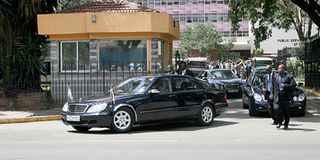
The presidential motorcade, one of the trappings of power African presidents love. The new constitution reduces the power of State House.
What you need to know:
- New constitution whittles away powers of the occupant of State House
There was an interesting incident at the end of February 2008 when President Kibaki, Prime Minister-to-be Raila Odinga and chief peace negotiator Kofi Annan assembled on the steps of Harambee House to announce “We have a deal”.
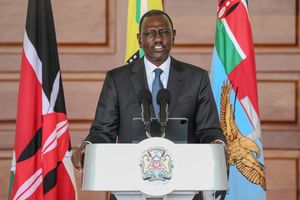
The announcement of the historic power-sharing pact between the leaders of PNU and ODM designed to halt Kenya’s spiral into anarchy had been delayed for nearly an hour because officials at the Office of the President insisted on dispatching a car to State House to fetch a lectern emblazoned with a seal bearing the coat of arms and encircled by the words “President of the Republic of Kenya”.
For them it was vital to demonstrate with that symbolic piece of furniture that the power-sharing deal still left President Kibaki wielding supreme executive authority.
It was only after the lectern was in place that the two principals, the chief negotiator and the respective entourages assembled before an expectant crowd.
President Kibaki addressed the crowd from behind his lectern, and then invited Mr Odinga to speak. But, as he made his way to the bank of microphones, State House flunkies rushed forward and whisked the emblematic lectern away.
Mr Odinga had to speak from a modest platform. With that gesture, a small group of courtiers had demonstrated just who exercised executive authority.
As the grand coalition took shape, some officials at the OP and State House devoted time and energy to demonstrating that President Kibaki retained the sole executive power despite the wording of the agreement giving Prime Minister Odinga an equal share of power and responsibility for day-to-day coordination and supervision of the government.
It was the frequent and often clumsy attempts to keep the PM in his place that sometimes provoked him to angry public outbursts; most notably the infamous complaint directed at the Coast provincial commissioner on a makeshift dais provided for a public function bereft of a red carpet, washroom and other amenities.
The manoeuvres around the President and the PM, and parallel ones around the status of the Premier against Vice-President Kalonzo Musyoka, may have seemed petty, and sometimes childish and comical.
But they reflected the power play around the two offices that goes back to the clamour for the establishment of a prime minister’s office.
Proposals in the Bomas draft constitution provided for a prime minister to assume executive authority while the president retained mostly ceremonial powers.
That became the main bone of contention because President Kibaki’s supporters could hardly countenance a situation where the popularly elected president was reduced to ceremonial functions while executive power was transferred to an unelected prime minister.
After tussling over the shape of the executive, President Kibaki’s men, led by then Justice minister Kiraitu Murungi, retreated to the Coast where they came up with the Kilifi or Wako draft that retained the executive presidency and relegated the premier to a position of no more than Leader of Government Business in Parliament.
That was the version defeated in the 2005 referendum, followed by Mr Odinga and the “Orange” camp being removed from government.
At that time, the popular view from President Kibaki’s court was that Mr Odinga was obsessed with usurping executive authority through the premiership route that avoided a popular election.
Fast-forward to the revived constitution review under the Committee of Experts and the their first draft that brought back a powerful premiership. Again, that became a contentious issue on the same basis that Bomas was opposed.
It was through debate on the same lines that the prime minister proposal was scrapped, a development that Mr Odinga had been expected to fiercely oppose. But, to the surprise of friend and foe, he went along with the proposal and became one of the key defenders of the proposed constitution.
The irony is that the same political forces that influenced the removal of the PM proposal as a means of hitting out at Mr Odinga were the same ones to campaign against the new constitution on grounds that it re-created the imperial presidency. It was an excuse that was soon abandoned because to many it was clear the all-powerful presidency had withered away even without a new constitution.
In acrimony
Under President Kibaki and two successive coalitions — the Narc pre-election pact that propelled him to power in 2002 before collapsing in acrimony after the 2005 referendum, the presidency has been shorn of the excesses and unbridled displays of power characteristic of the Moi and Kenyatta eras.
Under the present power-sharing arrangement, for instance, the President retained executive authority to appoint or remove Cabinet ministers, but he does not have power to hire and fire at will.
Appointments and sackings can only be done in consultation with the Prime Minister. In fact, touching ministers from the ODM side of the coalition is a no-go zone.
Other senior appointments such as permanent secretaries, police and military chiefs, parastatal heads, judges and ambassadors remain a presidential prerogative but only at the formal level of signing appointment letters or Gazette notices.
The power-sharing agreement codified under an Act of Parliament stated that all major decisions, including presidential appointments or major policy issues, must be made in consultation with the premier.
Mere rubber stamp
Parliament has in the interim taken away many of the President’s powers on appointments of officials, particularly to key commissions appointed under the Agenda 4 reform programme and important institutions such as the Kenya National Commission on Human Rights and the Kenya Anti-Corruption Commission.
The President merely rubber-stamps appointments made by Parliament.
The new constitution reduces the powers of State House still further. The power to give out public land enjoyed by Presidents Kenyatta and Moi will be no more. The President will still appoint and remove ministers (now called cabinet secretaries), the attorney-general, the secretary to the cabinet, permanent (now principal) secretaries and ambassadors, but all must be approved by Parliament.
The President also loses the prerogative to summon and dissolve Parliament, which will now have a fixed legislative calendar.
President’s secret weapon
Neither will General Election dates be determined by the President. Former President Moi, in the early years of the return to multipartyism, delighted in pointing out that elections dates were his “secret weapon”.
He and President Kenyatta had perfected the art of keeping unruly MPs in check by threatening to dissolve Parliament early and send them all back to seek a fresh mandate.
The new constitution is largely silent on the outward manifestations of the imperial presidency that might be retained more for show than substance.
When Kenyatta assumed, unelected, the presidency, he also assumed the trappings of power exercised by the departed colonial governor on behalf of the Queen as Head of State. The military aide de camp, the motorcade, entourage and security detail are more a show of pomp, power and glory not necessitated by any pressing security concerns.
Other than on matters such as parliamentary approval for presidential appointments, the real impact of the new constitution on State House will be seen in devolution and the establishment of institutions that are not dependent on presidential generosity.
For instance, dilution and dispersal of the Treasury’s hold on the purse strings means that nobody will have the blank cheque to dispense largesse or loot public coffers through schemes such as Goldenberg and Anglo Leasing.
Devolution also means the President will not have powerful officials all over the country in the form of provincial and district commissioners doing his bidding.
The new county administrative and legislative structures will be largely independent of the control and command structures at State House and the OP.