Inside the walls of the house that kept Kenya’s dark secrets
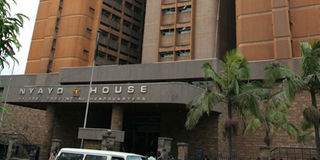
Photo/FILE
The building that housed basement torture chambers where Kenyans deemed to be too radical or opposed to the Moi presidency were locked up and beaten senseless to confess to crimes they did not commit.
When Nyayo House was completed in 1983, it was a sight to behold.
With the exception of Kenyatta International Conference Centre, it easily dominated Nairobi’s skyline from its location at the junction of Uhuru Highway and Kenyatta avenues.
But behind the facade of modernity lay dark secrets, some too awful to recount.

The building housed basement torture chambers where Kenyans deemed to be too radical or opposed to the Moi presidency were locked up and beaten senseless to confess to crimes they did not commit.
To many people, it was just another government building. Since it housed several government departments, it was an extremely busy place, and this created a few challenges.
For some reason some lifts never worked, and the waiting area was often in semi-darkness. This prompted a former Nation columnist to write that every time he visited the building he was always of being mugged as he waited for the lifts.
There was a particularly notorious lift that would skip the fifth floor, then jump up to the eighth where the doors would refuse to open.
It would then descend to the fifth floor where it would finally open. For first time visitors, it was a confusing routine. For veterans, it symbolised the perils of visiting Nyayo House.
At the time, visitors never understood why the Administration Police officers never allowed them to use the stairs, even when they were just going to the first floor.
As a result there was always a crowd of people literally fighting to get into the lifts. Sometimes the APs would drive people out of the compound until order returned.
Over time, Nyayo House evolved into a bastion of corruption. particularly at the Immigration department where it was impossible to get a passport with paying a bribe.
The corridors teamed with middlemen who solicited bribes for officers in-charge of issuing passports, driving licences, road licences, permission to open a bar and letter to join Form One for Nairobi Province students.
Matters were made worse by the civil servants who were not only unfriendly but also bullish. It was a place many visited with trepidation.
Unknown to many people who frequented Nyayo House, there was usually at least one Kenyan undergoing torture in the building’s underground chambers.
Their horrors are now coming into the open through court cases and hearings of the Truth, Justice and Reconciliation Commission (TJRC).
Although some former detainees have won cases for compensation for torture and unlawful confinement, most are yet to recover from the physical and psychological injuries.
“No amount of years or counselling can get me over the hurdle of what this building symbolises in my life,” lawyer Wanyiri Kihoro told the Sunday Nation.
Mr Kihoro, like most detainees, was locked up and tortured in the building before being sent to prison. He said most of the detainees were Kenyans the government considered to be dissidents in the 1980s.
After being tortured for days, the detainees would be taken to court at dusk where they would plead guilty to charges of sedition rather return to the dark chambers.
“People would get shivers just from passing by the building’s entrance. It was shrouded in so much mystery that it would seem your own personal demons came alive with each step towards it,” says Mr Kihoro.
Last month, former Subukia MP Koigi wa Wamwere became the latest Kenyan to be compensated for the suffering he went through while in detention.
The government did not deny the torture allegations and based on previous settlements, the court awarded him Sh2.5 million as damages and compensation.
Trail of contradictions
The government insists the torture chambers were never part of the building plan. And no one is saying at what point the building became into the torture headquarters for the country.
Mr AA Ngotho, who served as the chief government architect when Nyayo House was built, told the Nation in 2003 that the building was set up to house Special Branch offices.
During construction, his department was directed to only deal with three people: Two senior officers from the Special Branch and Mr Parkins, a British national whose role in the project Mr Ngotho claimed not to know.
“Mr Parkins would come and change the plan from time to time. He never said why or what the building was for. The Special Branch had its team of technicians who did the electrical fittings and fixed the telephone system,” he said.
Apart from Nyayo House, the Special Branch also operated from Nyati House on Loita Street that also housed torture chambers.
Mr Ngotho, who died in 2003, promised to put the record staright about the building. He dismissed claims that housed torture chambers.
“We are trying to put together a correct documentation of events that transpired within these walls, to address these fake claims by charlatans about what went on at Nyayo House,” he said.
The initial plan for the building, mooted in 1973, was for the Nairobi Provincial Headquarters. The original building was supposed to be 14 storeys tall and called Nairobi House. The basement was reserved for parking government vehicles.
But the plan was changed in 1979 when construction started. Daniel arap Moi had become president in 1978 on the death of President Jomo Kenyatta.
The design was done by the Ministry of Public Works and the contract awarded to Laxmanbhai at a cost of Sh218,608,377.
A year later, a note was made on the building plan indicating that all doors from the lift, except those to the basement, the 5th, 10th, 15th and 23th floors, were to be sealed with concrete slabs. Who issued the order remains a mystery.
In a previous interview, the contractor said they were instructed to ensure the lift served “only those departments which needed access to the strong rooms”.
The contractors claimed they were told that the rooms that later evolved into torture chambers would serve as safes for secret documents and cash by government departments.
One specification for the walls and roofs for these rooms was: a double wall, six inches thick each with sound- proofing.
A few weeks ago, Mr Mutemi Mulyungi, the secretary at the Ministry of Public Works, backed these claims while fielding questions from the TJRC.
“We constructed 12 strong rooms to keep daily cash collections from the Kenya Revenue Authority, passports section of the Immigration department and other valuable documents,” he said.
The doors were to be made of steel and five millimetres thick. To convert the rooms into torture chambers, the Special Branch installed controls to flood the cells with freezing water or blast them with hot gritty air or clouds of dust.
There were 12 chambers, each measuring eight feet by 10 feet by seven feet and painted either black to absorb all light or red. Mr Mulyungi said the walls were built with reinforced concrete to resist fires and deter intruders.
“We designed them as safes so that if the building caught fire, they would not burn,” he said when presenting a copy of the original plan to TJRC.
The rooms, which had heavy doors, were “not naturally ventilated” and were sound-proofed. They were artificially aired through special piping in the roof and walls.
There was also an open space which the architects said was intended to be a washing area.
But former detainees told the truth team that the open area was at time used as a toilet where detainees attended to calls of nature as the police watched.
Back then, the fifth floor was and still is the office of the Nairobi Provincial Commissioner and senior officers in the Provincial Administration.
The other three floors are said to have housed Special Branch, which has since been renamed the National Security Intelligence Service.
Former detainees say the 23rd floor was the interrogation office. The penthouse was initially designed for the caretaker.
The original plan indicates that it had a dining room, a kitchen, a lobby, a store, a servant’s quarters, two bedrooms and a store.
But the caretaker never moved in, and the Special Branch turned it into a vale of tears. Mr Mulyungi told the truth team that his ministry handed the building over to the Ministry of Internal Security in 1983.
Today, Nyayo House is busy as ever, but it has undergone a remarkable transformation since 2003 when President Kibaki’s Narc Government assumed office.
The torture chambers were opened to the public for the first time, and political detainees were encouraged to recount their days of horror.
This was, according to then-Justice Minister Kiraitu Murungi, the only way to banish the ghost of political repression that defined the Moi era.
Today the reception area is well lit, and the queues waiting for the lifts more orderly. The staircase is open to the public, and the APs at the gate are friendlier.
There are no more scared floors or intelligence officers lining up in the corridors to dissuade dissidents.
The Immigration department has been revamped, and you no longer have to bribe to get a passport; is usually takes just two weeks.
Gone, too, are the middlemen who jammed corridors.