When necessity invented global SoS
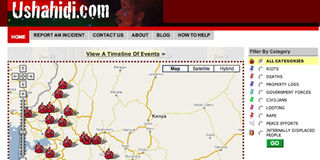
Ushahidi website that was used to map incidents of post-election violence. Photo/ JAMI MAKAN
It was the first week of January. Bitter post-election violence raged across the country.
But 31-year-old Kenyan blogger and Harvard-educated lawyer Ory Okolloh had other things in her mind as she followed the shocking headlines minute by minute: “Man hacked to death.” “Police thwart rally.” “Church torched by armed gang.”
But the information seemed scattered and incomplete. She was hearing different things from different people.


She had a hard time getting an overall picture of what was happening, and this was made worse by the Government ban on live broadcasting.
Didn’t know
“There was a lot of disinformation,” Ms Okolloh recalls. “People did not know what was going on.”
So she telephoned an acquaintance Erik Hersman. Wouldn’t it be helpful, she asked him, if Kenyans could use text messages to report violence cases, which could then be mapped out on a website?
Wouldn’t this allow everyone, she thought, to see where problems were occurring instead of having to get updates from leaders who often had their own agenda?
That was a Thursday. On Friday, Erik described Ms Okolloh’s idea to David Kobia, a Kenyan software developer living in the US state of Alabama.
Erik and David had never met, but they knew each other online. By Saturday, they had assembled a prototype of the website. On Tuesday, the site was live and ready for use.
Ms Okolloh’s team decided to call the site Ushahidi, which roughly means “testimony” in Kiswahili. It allowed anyone to submit reports of violence by sending a text message to a Safaricom/Celtel shortcode.
Kenyans could even send pictures and videos. After verifying the accuracy of the submissions, her team placed the data on the site’s map and timeline.
Because they had no money to advertise the site or the shortcode, they received just 220 submissions from people who heard through word of mouth.
Now the team has big plans. Similar versions of the software can be used all over the world by NGOs to monitor anything, including endangered species, HIV infections, deforestation and violence against women.
The Ushahidi founders, who include Kenyan journalist Juliana Rotich, have recruited a dozen volunteers from Kenya, Ghana, Malawi, the US and The Netherlands.
The updated software could be the most important application from Africa. Sitting at a café in Nairobi, Erik Hersman, the tall, bearded software developer, looks like any tourist.
But he grew up in Kenya, the son of Christian missionaries who did Bible translation.
He attended Rift Valley Academy, an American boarding school, before going to university in Florida. “I’m pretty much the only white guy in this entire thing,” he said.
A redesigned version of the website to be distributed to civil society groups free of charge is in his laptop.
“We have had a number of large-scale riots, so we have the urge to set up an SMS gateway,” says Awab Alvi, a Pakistani who runs Don’t Block the Blog, which monitors censorship in Pakistan.
According to Joan Razafimaharo of Foko Madagascar, a group that raises awareness about environmental issues, Ushahidi could prove beneficial.
“It will help us report events that may occur during a cyclone tragedy,” Ms Razafimaharo said, noting that tropical cyclones hit Madagascar each year, causing millions of dollars in damages and hundreds of deaths.
And Shahrzad Nouraini, who works for a development NGO in Kibera says Ushahidi can be used for feedback. “It will allow Kibera residents to respond to us.”
Ms Nouraini says her group, Carolina for Kibera, will start learning how to use Ushahidi in a few weeks.
But some experts are still cautious. “If the emergency is an earthquake, people are not going to be sitting at computers waiting to get information… they are going to run,” says Prof Michael Cervieri, who teaches new media journalism at Columbia University in New York.