The choirmaster who played the last note for Kenyatta speaks
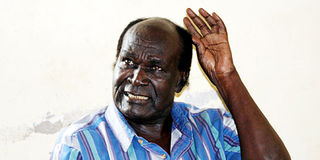
Mzee Enock Ondego. PHOTO/LABAN WALLOGA.
What you need to know:
- Ondego recalls his days as a confidante of Kenya’s first head of state -- and the sad day his friend died
Enock Ondego’s story begins in a village called Mazigolo, Kenya in what was then known as South Maragoli in Western province, where he was born in 1930. He started teaching at 17 and would soon leave for Nairobi to join the pre-independence clamour for African political rights, working with the likes of Tom Mboya, James Gichuru and Jaramogi Oginga Odinga We pick up his story shortly after independence after his attempts to run for the Mombasa parliamentary seat were thwarted by Kanu in favour of home-grown Juma Boy.
After being (rejected) by the new government I decided to go back to teaching. I was posted to Kwale district. I did not want to go to Maragoli.
“I taught at Samburu primary school near Maji ya Chumvi, on the main Mombasa-Nairobi highway. We were all very happy, and Kenya was celebrating – I started to compose songs crying for our struggle and praising our new country and the new leaders.


This is how I became the first teacher to sing for the president. When Kenyatta was on his way to Mombasa, I arranged that we would come to the road to cheer. I was the first in Kenya to do this. Before me choirs were only in churches.
Now there is something I have not told you.
In Nairobi things were terrible. Even if I was not a Gikuyu, I was very moved by the things the colonial government was doing. I saw a lot. I saw women in Shauri Moyo.
They made them sit with their legs open and their skirts hiked. Then – I am a man of God, it is improper to say this – the askaris molested them with Tusker bottles – the long Tusker bottles… they would put in between her legs and one would kick with all his strength, until the woman collapses.
It was this that made me start to compose.
Then, one day I saw a blue tractor with a harrow. There were Gikuyu women chained to the harrow with one hand, and to the bridge with the other, the bridge above the dirty water in Pumwani. There were 7 women.
They were asking them, “Where are your husbands?”
“We don’t know,” they were saying, “We don’t know.”
“So you die,” said one of the Askaris.
And one of the women said, “Then we will be with God.”
And so the tractor roared into action, and the women were dragged, and started to hit each other as they were stretched, and they were pulled until they died there. I saw everything...the blood, the screams…they kept calling God’s name. Ngai, Ngai.
I felt a lot of pain.
And that was the subject of the song I sang for Kenyatta, and when he heard my children singing, he cried.
We also sang the other song, Kenya’s most famous independence song. Did you know that I composed it?
The song is called “Huu ni Wimbo wa Historia (This is a Song of History)”:
This is a song of history, pray everybody, listen with all your ears/
In October 1952, we heard that Kenyatta had been arrested/
He was not arrested alone but they also arrested the heroes of independence/.
Oooh....ooooh
Kenya was raining tears, we began to despair/
Fathers, mothers and children pleaded for Kenyatta to be released/
Then the news came from Kapenguria, that Mzee had been sentenced to seven years with hard labour/
So the troubles started and many people died/
The father of out nation left prison and united our leaders in KANU/
When he went abroad, they threw rotten eggs at him/
He came back carrying our new constitution/
On December 12th 1964, Mzee raised our flag/
He asked us to forget the past and build our country/
He said ‘Harambee’
and now we know Harambee means together
Thank you our father/
Thank you our father we pray for your life .
You could hear the children’s voices singing there on the road that day, and it was beautiful. Mzee Kenyatta listened to all the songs.
Do you of anybody who saw Kenyatta shed tears? Police stopped all the cars coming to and from Nairobi, and they all heard us singing. It was very powerful. People came out of the cars and started clapping.
Mzee asked me where the school was, and I pointed it out to him. He told me to have uniforms made for the choir, so they can go to sing in State House, Mombasa.
It was the fifth month of 1964 that I started to go to State House to sing. The Mzee would come to Mombasa in April, August and December, when his children were out of school. He loved Mombasa.
We were taken by the community lorry. I would not rest when he was in Mombasa. I performed with my choir everyday. Mohal Lal, an Indian man, made our uniforms.
The first choir had 62 children.
It was at this time that I composed the song that everybody in Kenya has come to love. It is also Kenya’s most loved freedom song:
Kenya Yetu (Our Kenya)
It is a thing of wonder, our Kenya
Let us hold hands and make it come to life
Many of us shed blood
But we must let go of what has passed
And build our Nation
Keeenya, is ours
We love it, for it has brought togetherness
Keenya, is ours
Our love for it is strong…
When Mzee heard this song, he said it must be taught to the police band. They sent me to Kahawa to teach the band. I taught them, and they played it for Kenyatta, and he told me that I was only to perform the song on State occasions.
So we found a routine.
When the president needed me, a message would be sent to the District Commissioner, who would summon my local chief, and a car would be sent for us.
There was always a stage and shelter for Kenyatta and the VIPs. When the President approached, there was a whistle and we stood up. Kenyatta would wave to the public to relax, and then we would start to perform. By this time there were different groups: dancers and other traditional performers.
I was very well known now. I was not born again yet. So I would arrive and the Presidential escorts would take me behind their canteen and I would have some beers.
They were very moved by my songs. Once I was asked to compose a song in three days, to welcome Emperor Haile Selassie at Port Reitz. He was a good friend of Kenyatta’s. He visited Kenya in 1967, 1968 and 1969.
Another time, Mzee asked me to conduct a mass choir; I had now 2,600 children from six choirs for the opening of the “Uhuru na Kazi” building in Mombasa. I conducted them all while standing on a table.
That day Mzee said I was to be promoted to P1 straightaway.
Although there were many groups now singing for the President, and many people started making things difficult, if Kenyatta found we were not at an event, he would fire those in charge of the programme.
Other times we were in State House, and he would wave away the dancers, the likes of Mwomboko and Nyakinyua and call for the Mwalimu.
“Bring on the Teacher,” he would say, “bring on the Teacher.”
We would sing 8 or 9 songs, I would get very tired, and people got upset at me. I was never paid any money by Kenyatta. Kenyatta only gave money to people from his tribe.
Nyakinyua got millions, and beach plots in Mombasa. The only gift I got was a promotion to P1. He gave money to the Gikuyu basket weavers at Mwembe Tayari. Nyandarua group were also given a lot of money.
In Gatundu he would receive so many Gikuyus. One day he asked those who wanted money to raise their hands. They raised them.
Then he asked them to move to one side. Then he asked those who had come for shambas. They moved to another side.
Then he asked his Askaris to chase the ones who came for money, they beat them away. Those who came for shambas queued, and the PC started taking their names down. I used to go to State House and he would ask me, “Maragoli who taught you these things, all these words you sing?”
And I would tell him I am just talented.
Once, he took me alone to his special room, and opened his cabinet, full of many bottles of expensive alcohol. And we drank together.
But I lie, there is a time I got money from Mzee.
After some years, I became tired and decided to desert Kenyatta. It was very difficult. He loved Mombasa - he would stay all of April, and leave in May. Then August to September.
Then the whole of December. So while every other teacher and student was on holiday, I was conducting. Everyday I was conducting.
For seven years!
The choirmaster took a bus to his rural home where he remained for several years while Kenyatta asked after him. Finally, he was traced to a hotel where he had found a job as a waiter and taken back to Kwale in 1974 on orders of the Coast provincial commissioner Eliud Mahihu.
In the car, they said, “You know, Mzee has asked us to take you to Kwale.”
We drove…vrrrrr...until the Likoni ferry. We crossed and went straight to the DC’s office. This was in ‘74. From the DC’s I was taken to Kwale Primary School.
Then I was told, by the DC, “This is where you will be. We have told the people from Kenya National Union of Teachers that there will be trouble for them if you disappear.”
They gave me a house near the road. And there was always The DC’s Land Rover parked nearby, watching me. Sometimes Mzee came to the DC’s grounds just to be sang for.
We got new uniforms. Kenyatta, all those years, ordered new uniforms seven times for my choirs. So from that day, I never missed performing for Kenyatta, until he died in 1978.
In fact, we played for him the day he died.
This was in August of 1978. That week he had been strange. He was asking us to play for him a lot. He seemed all right, but you could not see his eyes. He was wearing spectacles.
On the Monday, we were told we were going to sing for him in Tiwi. We sang there for one day, then the Guard told me he said he did not want to be there.
So we left and went to Msambweni, a place called Bombeni. He had called all the Cabinet and ambassadors and his family.
They had built a huge stage, 30 feet long. There was a toilet in the back and a place for him to go and rest. They planted flowers.
The place is still there.
By the end of the fourth day, all the family was there. Then he said he did not want anybody to sing, just my choir. So I went to the stage. We started performing.
But after a bit, I noticed that he looked strange – I looked at his hand, and there was no fly whisk! It was made of a cow’s tail. I had never seen him without it – but now it was sitting between his legs. Then it fell, and it was taken to the car.
Usually we had a signal, I would put one hand up when we needed a break and he would signal that we could stop. After 5 songs, I was tired. I had tried signalling but no response. I bowed to suggest we leave, but he raised his hand, signalling that we continue.
After 8 songs, he looked at Mahihu, and they surrounded him and took him to the toilet. That child of Peter, the one from Juja, took the fly whisk from the car and put it in his hand.
It was during the 9th song that Mzee collapsed. He was surrounded immediately. Somebody ran to the door and pushed a button and the door was open.
Then they lifted him through the back to the car. I am telling you people must have died that day because the car mowed through the crowd. It was Ramadhan, so there were many people. They left so fast, even the guards did not know Mzee had left.
His wife and Mahihu were in the car. Cars followed...ni noo ni nooo... They were screaming. But on the way, the car met Dr. Mngola’s car coming to see the Mzee, and they turned back. We thought he had fainted.
We were told to go home. That a car would come for us the next day. We waited but the car did not come. At 1O’clock we heard that he was dead.
That day I wondered how stupid I was. He used to tell me, “open there, take anything you want.” The fridge had a glass door, and made a sound like khrrrr, and I would take two beers and be drunk.
If I had been wise I would have told him that I had no land. So I started crying and the children started crying.
They came to pick us up for the wake – and we saw his oiled face.
He was glowing.
The Life of Mzee Ondego, an autobiography, is published by Kwani? Trust © 2009. Copies of the book are available directly from Kwani Trust from today and from all leading bookshops from August 2.
Price: Sh300