Kenya Airways staff call off strike
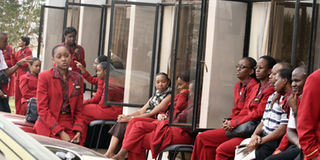
Kenya Airways staff went on strike on Friday demanding a 130 per cent pay rise. The workers have now agreed to resume work following an agreement with the airline's management. CHRIS OJOW
Kenya Airways (KQ) workers have called off their strike, after reaching an agreement of an interim 20 per cent salary increment with the airline’s management.
This followed a series of meetings held on Saturday between the Aviation and Allied Workers Union, representing the workers, and KQ management.
Consequently, all staff will be required to return to work by Sunday 6 pm


The agreement also includes the withdrawal of all dismissal letters sent to the striking workers on Saturday. A pending court case on the dispute will be withdrawn during the appearance on Monday.
The parties also agreed that there would be no victimisation of either groups.
The pay agreement will be staggered in two phases, 10 per cent of which will be paid this year and the remainder next year
On Saturday night, trade union officials and KQ management were locked in tense negotiations to resolve the deadlock that could have taken a huge toll on the reputation of the national carrier and cost the economy millions of shillings.
The two groups held a joint press conference on Sunday morning at a Nairobi hotel to announce the return to work formula following the negotiations that had been mediated by the Central Organisation of Trade Unions (COTU) and Federation of Kenya Employers (FKE)
The national flag carrier will now to grapple with the daunting task of reducing the backlog of passengers whose travel plans had been affected by the three-day workers' strike.
"There are no losers or winners, what we have given is the best solution to the crisis," Dr Naikuni said in a news conference at the Stanley hotel.
While announcing the decision to call off the strike, Aviation and Allied Workers union secretary general Mr Jimmy Masege accepted the interim package and called for the need for urgent job evaluations for union members.
"The dust has settled so be free to go to work," said Mr Masege, adding he would involve COTU and FKE in future negotiations with the airline.
However, Mr Masege defended the 130 per cent demand saying with the recent shift in the economy, the staff had reason to ask for the pay.
According to Mr Masege, the amount applies to basic salary and allowances of the 3,500 employees whose salary ranges fall in the Sh8,000 and Sh80,000 bracket.
The airline promised to carry out a six month job evaluation exercise on staff to determine the grading scheduled to start in October this year.
The two parties have been in negotiations over an increment of workers salaries since April this year, and Sunday's agreement marks the beginning of what the employees term as a friendlier salary system.
The return-to-work formula was agreed on after twenty-nine consultative meetings between the airline and the union, the last of which was arbitrated by Central Organisation of Trade Unions and the Federation of Kenyan Employers on Saturday evening at the Company's headquarters.
AAWU headquarters in Embakasi flocked with employees as they lay in vigil awaiting a decision from their union leaders who had gone into consultation with the airline.
At Pride Centre, the Kenya Airways headquarters, the trade unionists and the COTU delegation lay in wait as Dr Naikuni and his team consulted in a separate newsroom.
Tension was high as Mr Jimmy Masege and AAWU treasurer Noah Sitienei paced at the airline headquarters consulting with other officials on phone at a separate room presenting package offers that the management was adamant to accept.
We will spend the night here if need be, Mr Atwoli had said on Saturday evening.
Nine hours of intensive negotiations was the duration it took to arrive at a package which according Dr Naikuni was amicable to both parties Mr Atwoli was accompanied by Mr George Muchai and Mr Isaiah Kumba, COTU deputy secretary general and board member respectively.
Both teams are said to have stood firmly on their grounds, each threatening to walk out, but with the already accrued losses by Kenya's flag carrier they arrived at a mutual cause.
Having suffered at least nine flight cancellations per day during the strike called by the Aviation and Allied Workers union, Kenya airways promised to catch up with the losses the incurred during the period.
The huge numbers of the stranded passengers will be solved urgently, said Kenya Airways managing director Titus Naikuni adding it was too early to speculate the loss the company had incurred during the strike.
Mr Naikuni promised to cut down on the delay hours by using larger planes to accommodate the high number of passengers to the affected areas.
We are working diligently to solve the crisis, said Dr Naikuni pointing out West Africa as having the highest number of cancellations.
Dismissal letters that had been issued to the staff were lifted with the airline promising not to victimise any staff for participating in the strike.
Trade unionist Mr Masege is set to appear before Mr Justice Paul Kosgei of the Industrial Court today after they were charged with inciting a work boycott and defying a High Court order blocking the strike that had began on Friday.
The two trade unionists, two Kenya Airways cabin staff, and two aviation students were accused of taking part in an illegal assembly.
They were also charged with Mr William Ong'ere, a Kenya Aviation and Allied Workers Union (KAAWU) official, alongside two Kenya Airways employees, Rosemary Tipis and Vivian Opiyo, and Ezra Oyaro Osoro and Walter Kenya Kabaja, students who were on attachment.