Local fruit tree holds key to malignant cancers
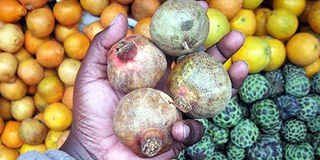
Extracts from a fruit tree found in many parts of the world have shown dramatic success in killing cancerous cells in the lung, breast, prostate, colon, liver, ovarian, cervical, breast, bladder and skin.
The annona tree family has over 110 species mostly growing in the wild with the main ones being Annona muricata found in the Amazon rainforest and the Annona cherimola, which is grown locally and known as matomoko
What you need to know:
- Plant extract has shown a dramatic level of success in destroying cancerous cells in the human body
A close relative of a well-known fruit tree found in Ukambani, Taita and Voi could hold the key to a cure for some of the world’s untreatable cancers.
Commonly known as soursop or custard apple, the plant belonging to the Annona species has shown dramatic success in destroying lung, breast, prostate, colon, liver, ovarian, cervical, breast, bladder and skin cancerous cells.
Laboratory studies funded by the United States government through the National Cancer Institute and National Institute of Health and carried out by Purdue University show that a chemical compound in the plant selectively kills cancerous cells, leaving healthy ones unscathed.


The most dramatic is a recent study by the Catholic University of South Korea and published in the Journal of Natural Products showing that an extract from the plant was 10,000 times more effective in killing colon cancer cells than the drug currently in use.
The Annona tree family has over 110 species mostly growing in the wild in many parts of the world, with the main ones being Annona muricata found in the Amazon rainforest and the Annona cherimola, which is found locally and is commonly known as matomoko.
The tomoko fruits that grow in the drier parts of the country are much smaller compared to recent hybrids that grow in higher areas in parts of Murang’a and Kirinyaga, in Central Kenya.
Mainly because of its abundance in the Amazon rainforest and proximity to major research institutions in the US, the Amazonian variety has received the biggest share of academic research and commercial attention.
Because of this attention, the Amazonian Annona has spawned a global commercial brand, Graviola, which is being traded in many parts of the world as a health supplement.
The supplements, which are readily available on the Internet, are touted as the ultimate cure for a host of ailments.
Small quantities
However, other members of the tree family have been found to contain the chemical ingredient Annonaceus acetogenins, which is responsible for its anti-cancer activity.
This chemical ingredient, found in most parts of the plant but in different quantities, has been shown in laboratory tests to have strong anti-tumour properties even when administered in very small quantities.
Research reveals that the plant has been used for medicinal purposes, including curing of cancer, for thousands of years. But is only in the last two decades that the tree has attracted conventional researchers.
In Kenya, the fruit is quite popular, especially among the Asian community and foreigners and is readily available at the major markets in the city. Currently it is out of season.
“Matomoko are some of the best selling fruits in this market. My main customers are Asians, Arabs and even whites,” said Mr Eric Mutua, who has been in the business for the past seven years at the City Market.
At the Ngara open market in Nairobi, only one trader, Mr Simon Ndung’u had a handful of custard apples for sale which he said were leftovers from the previous season.
Mr Ndung’u said that his clients are usually herbalists.
“The herbalists say that if the fruit is crushed and mixed with pomegranate (Punica granatum) and other herbs, it can be administered as a cancer treatment,” said Mr Ndung’u.
He sells one custard apple fruit for anything between Sh10 and Sh20, depending how affluent a client looks.
Local herbalists
At major supermarkets, a kilogramme of the fruit sells for Sh200 while at the City Market one can buy a kilogramme for Sh150.
At open air markets like Ngara and Wakulima, a single fruit costs between Sh10 and Sh30.
Emerging scientific evidence, which is freely available on the Internet, and abundant online sales of Graviola health supplements for a myriad of health complications including cancers, may have emboldened some local herbalists in recent years to claim that they have the capacity to cure malignant tumours.
However, the director of Medical Services, Dr Francis Kimani has warned herbalists against advertising any such product without permission from the Pharmacy and Poisons Board.
Dr Kimani is emphatic that any person claiming to have a cure for chronic diseases such as cancer and others must register their products with the Medical Services ministry.
Sticky situation
“The public must demand evidence of such registration before accepting treatment,” he said at a recent media briefing.
But the fact that such herbalists can now cite some conventional scientific data to justify their claims could put the ministry in a sticky situation.
Several of the studies indicate that the active ingredient in the fruit, Annonaceus acetogenins, must be administered in very small doses otherwise it could be dangerous.
Some of the studies also warn that continued use of the compound could lead to the development of early Parkinson’s Disease, a degenerative disorder of the central nervous system.
This has been discovered to be particularly the case when people use the crushed seed instead of the leaves, bark or the fruit pulp recommended by researchers.
A city-based herbalist who requested anonymity for fear of antagonising the Pharmacy and Poisons Board and claimed to use matomoko for treating hypertension disagrees.
“This could be true with conventional medicines, which are highly refined, but not so if the product is administered in its natural form,” he said.
Dr Geoffry Mbijiwe of the Capito Herbal Clinic in Nairobi told the Nation on Friday: “Tomoko is a very common fruit. Though I have not used it for medicinal purposes, I am aware of the growing scientific interest in the fruit and hope any benefits from the research will be used responsibly.”
Although the research community has enough evidence that the tomoko family could greatly contribute to a miracle cancer treatment, it is still many years before a pill could be put on the market because of scientific challenges and red tape.
Research on the custard apple has so far failed to develop a patentable product. And since the natural extract cannot be patented, the pharmaceutical industry has to find a way to make a patentable product but which will not lose its anti-tumour properties.
If the development of another successful cancer treatment drug Taxol, from the Pacific yew tree is anything to go by, then sufferers could be in for a very long wait.
Taxol, one of the newer chemotherapy drugs, is an extract from the bark and needles of the yew tree, Taxus brevifolia, and is used in the treatment of ovarian, testis, breast, head, neck and lung cancers.
While it has taken researchers almost a decade to successfully chemically produce the main anti-tumorous ingredient, annonacin, from the custard apple, it took 30 years to put the commercial product Taxol on the market.
Make a killing
Medical lobbyists who are accusing pharmaceutical companies of dragging their feet in availing what they call a miracle drug due to profit considerations, are suggesting that rich governments step in and help put the drug within reach of cancer sufferers.
They say rich governments could fund basic research like the US is doing through a body like the World Health Organisation which would ensure that generated scientific knowledge would be freely available to interested parties without paying for intellectual property rights.
Meanwhile, at a practical level Kenyans will continue buying Annona products from the Internet as health supplements or from the unregulated alternative medicines sector while the rest of the world makes a killing from the Graviola brand.
The flesh of the ripe tomoko is usually eaten by hand or scooped out with a spoon. Occasionally it is seeded and added to fruit salads or used for making ice cream.
The juice can also be diluted to make a refreshing drink. In some instances, the fruit has been fermented to produce an alcoholic beverage.
Additional reporting by Isaiah Esipisu