How plan to privatise railways became Kenya’s public sector reform nightmare
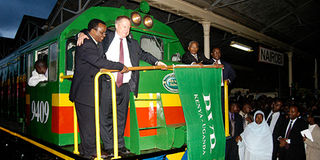
The flag-off ceremony of the new Rift Valley Railways in 2006, which has turned out to be Kenya’s biggest nightmare in its privatisation bid.
Photo/FREDRICK ONYANGO
What you need to know:
- Desire to save face traunched the reality that Kenya and Uganda were handing over a national asset in a fundamentally flawed deal
After Mr Roy Puffet ambushed Kenyan and Ugandan government officials with the dramatic revelation that he did not have the $5 million (about Sh400 million) they were expecting — and that a day before they signed a contract that would hand him the running of the Kenya-Uganda railway for 25 years — the transaction team took what had become a standard operating procedure: just bend the rules for the guy.
Months earlier, Mr Puffet had run a well orchestrated media campaign in which he ensured he extracted all the concessions that he needed to sweeten the deal.
He had demanded that the Kenya Government takes over all debts that were owed to the Kenya Railways pension fund. He fought hard to ensure that the government took the decision to fire 6,000 workers at a time when President Kibaki’s government was very unpopular.


The World Bank extended a Sh6 billion loan to pay off the sacked workers. But, despite all these concessions, Mr Puffet turned up with an empty pocket on November 1.
According to experts who have been involved in such deals, it would have been possible to detect that Mr Puffet did not have money right from the start if the due diligence conducted was thorough and if the Treasury had demanded for guarantees that the money is available.
Save situation
To save the situation, the governments and the International Finance Corporation (IFC), which is owned by the World Bank, hastily amended the contracts by introducing two legal devices that would enable Mr Puffet to raise the money required in 30 days before he could be handed over the railway.
There was to be a wet signing on November 1, 2006 and a dry signing on December 1, 2006.
This grace period unleashed a major scramble to raise cash quickly to save the deal. Without this cash, the IFC and KfW (the German government agency that lends to the private sector) were not going to release their money, and this would imperil nearly Sh5 billion ($64 million) in project finance.
Mr Puffet and his financial adviser from PWC, Mr Vishal Agarwal, started by knocking on the usual doors looking for the cash at firms such as major private equity shops and investment houses, but many could not touch the deal — despite the world then being awash with excess money — because either the window to close the deal was too short, or they were put off by the political risk and the shareholding squabbles that plagued Rift Valley Railways (RVR).
With all options drying out, Mr Agarwal reached out to Transcentury, a local investment holding company that had been recently making waves to invest. Transcentury had recently made a series of good deals, starting with its investment in East African Cables, and later putting money into a private equity fund raised by Helios that would buy 25 per cent of Equity Bank for Sh11.2 billion ($150 million).
Though this was one of the biggest and most complicated deals that Transcentury had handled so far in terms of the political risks involved and scale of the asset, they came through with $9 million in the end, and saved the deal — and face — for everyone involved. Transcentury got a 20 per cent shareholding.
By hiring Mr Agarwal, Mr Puffet had made a smart move that would help feed directly into the Kenyan political and business networks. Mr Agarwal was the ultimate insider in the Kenyan corporate finance scene after handling the KenGen listing on the Nairobi Stock Exchange.
This gave him good connections with Ms Esther Koimett, the investment secretary, and Mr Eddy Njoroge, KenGen’s chief and a key investor in Transcentury.
Centum (an investment company controlled by businessman Chris Kirubi) and Babcock Brown (an Australian investment bank that has since hit on a lean patch) also came through with Sh375 million ($5 million) a piece that gave them 10 per cent each of the company.
Now Mr Puffet controlled the minimum 35 per cent that was required to hold on to the concession as the lead investor. IFC provided a Sh750 million loan ($10 million).
However, both the IFC and the German government refused to buy shares in the company because they had problems with Mr Puffet, and especially with the way he had handled himself throughout the deal.
They did not particularly like the fact that Mr Puffet did not pay for his shares and that the two governments had to make a special allowance to allow him to do so. He was even allowed to capitalise expenses amounting to Sh609 million incurred in bidding for the concession.
To this day, they have not honoured their commitment to buy shares directly in the company, but IFC continues to support the loan.
This situation presented a big problem — stemming from the way the concession deal was structured — that could plague the company over the next four years.
Because Mr Puffet had to maintain a 35 per cent stake (and he had already given out 25 per cent to his unhappy partners Rostam Azziz of Mirambo Holdings and Asif Abdullah of PrimeFuels out of the 60 per cent maximum that the law allowed foreigners to own) he could not sell more shares to raise money. No one could put in more money without diluting his 35 per cent stake.
IFC, fearing that Mr Puffet could easily sell his shareholding to someone they did not approve of and risk their loan, also signed a side deal (shareholding deed) that made him promise that he would maintain a minimum of 51 per cent of the shares in Sheltam Railway Company, his company that won the Kenya-Uganda concession during the 25 years.
Already, the company faced the challenge of selling 15 per cent to Ugandans within five years to meet the terms of the concessions. With Transcentury and Centum holding 30 per cent, someone would have to sell to make way for the Ugandans — which introduced the possibility that at some point the shares would be in play.
So, first, with IFC and the Germans refusing to put in more money, and the fact that existing shareholders could not buy more shares, RVR was handicapped when it came to raising cash to run the railway.
Second, the governments and its advisors neglected to separate the shareholding of RVR and the management of the company, but instead gave a carte blanche to Mr Puffet, a manager who had never ran a full-fledged railway business such as Kenya Railways and Uganda Railways combined.
This weakness in corporate governance would eventually feed into boardroom intrigues and the underperformance of the concession.
A happy man
On the day that he signed the dry lease, Mr Puffet was a happy man. Media images of him jumping on the railways tracks, and a few months later bathing in the after glow of the deal, will remain etched in the Kenyan mind as the metaphor of the failed concession, hailed as the best emerging markets deal by the respected Euromoney magazine — this in spite of the mess that insiders knew of the process and the outstanding issues.
For IFC, it was compared to the privatisation of Kenya Airways, in terms of how an excellent deal should be done. But, to insiders within IFC, this concession left a bad taste within the World Bank Group, with some of the bankers who shepherded it turning out to be the biggest critics of themselves.
It is simply considered one of the worst deals they have done, and the World Bank has officially acknowledged as much publicly through the various studies its publishes on infrastructure.
Upon taking over with $29 million in equity from Transcentury, Centum, Backcock and Brown, Mirambo, PrimeFuels and the loan from IFC, it became clear that running RVR was going to be a rough ride for shareholders. The $29 million was supposed to be used over five years. RVR was also expected to invest $25 million annually for five years in upgrading the railway and trains.
Before the railway was handed over, there were expectations that only 6,000 workers would be sacked. As much as Sheltam was expected to provide technical expertise from outside the country, it was also expected to build local capacity and promote good labour relations, given the fact that Kenya Railways had traditionally been a very politically sensitive institution.
However, within the first year of running the railway, Mr Puffet ruffled feathers with trade unions and politicians by firing 600 workers to the dismay of the shareholders and the government.
According to one big shareholder, Mr Puffet “filled up the place with expatriates from South Africa”, which irked senior executives who now had to deputise foreign managers —some of whom did not know the railway business as much as they did.
Besides, it was expected that the first visible sign of success was a train service that ran efficiently on time, regularly and profitably. However, operational decisions taken by Sheltam produced the opposite effect, which led to a major congestion at the Mombasa Port.
In 2007, the company closed the year with a loss of Sh477 million on revenues of Sh2.6 billion. Mr Puffet’s company earned Sh27 million in management fees for the six months he had been running RVR, and the concession fees owed to the government hit Sh325 million.
The company’s finances were in bad shape, with debts exceeding assets to the tune of Sh1.25 billion. Most importantly, the company was not meeting the operation performance targets set by the government.
In 2008, the problems continued to mount. With the company failing to meet revenue targets, finances continued to worsen and the investment programme to upgrade the railways and trains set in the concession agreement was falling behind. The governments were unhappy. For instance, RVR incurred a loss of Sh1.8 billion in 2008, compared to Sh477 million in 2007 on revenues of Sh3.7 billion.
These mounting problems threatened the concession, and this was making shareholders uncomfortable, but what triggered their action was the realisation that the Sh2.1 billion ($29 million) that was supposed to be used for five years had been spent in two years.
“Roy says it wasn’t his fault the money disappeared, but because the IFC loans were never fully drawn down,” said one person familiar with the details.
It was with this in mind that Transcentury started canvassing other shareholders to support its bid to engineer a boardroom coup that would remove Mr Puffet as the manager of the business and replace him with a local.
Transcentury believed that the Sh2.1 billion of equity the shareholders contributed was wasted on hiring South African expatriates, among other things, and they pushed for Mr Brown Ondego, formerly of Kenya Ports Authority, to be hired to replace Mr Puffet.
Some of the shareholders did not support this move, but Transcentury pushed its agenda through and got Mr Ondego. Some within the Transcentury group believe that Mr Ondego has achieved much than Mr Puffet did with Sh2.1 billion.