Why these young men are ready to die for religion
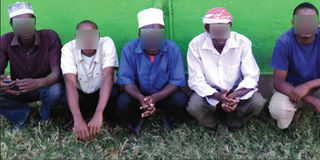
Six Al-Shabaab recruits in Dandora. The six, who have been looking for an opportunity to fight in Somalia say they fight is a righteous war without borders, race or tribe. Photo|KIPCHUMBA SOME|
What you need to know:
- Sunday marks exactly one year since the Kenya Defence Forces rolled in to southern Somalia to battle the militants blamed by the Kenya government for a series of cross-border incursions and kidnappings in the Coast.
- Even as Kenya and KDF celebrate the victory in Somalia, the six recruits are a sobering reminder that the shadow of terrorism is yet to pass. Al-Shabaab’s extremism and ideology lives on through the young recruits.
- Al-Shabaab was just one dark star in the constellation of the ultra-radical groups in the Muslim world dedicated to the cause of jihad, the holy war against the so-called infidels represented by the West and their allies.
The six Al-Shabaab recruits looked anything but the fighters they claimed they were. They were young, slight in build, shy with forlorn, distant looks in their eyes and seemingly unsure of themselves.
On a sunny Sunday afternoon, two weeks after the Kenyan troops had conquered Somalia’s port town of Kismayu, the militants’ last urban stronghold, the young Kenyan men told the Sunday Nation of their desire to cross the border and join the war in Somalia.
The setting was a madrassa in one of the four mosques in the larger Dandora area in Nairobi; not at all a grandiose building but which nonetheless has played a crucial role in the youths’ journey to Muslim radicalism or jihadism.


Hassan, 26, who had organised the meeting, said logistics had made it impossible for them to cross the border to fight the “invaders” as they referred to the Kenya Defence Forces and African Union troops.
The rest of them, Juma, 21, Ramadhani, 24, Ahmad, 30, Obeid, 23, and Salim, 22, nodded in agreement and then fell into a silent reflection. “But a way will be found soon, inshallah,” Juma said after a while.
Dressed casually in jeans and T-shirts, they lamented about Al-Shabab’s defeat by the KDF and reflected on what this portends for the movement in East Africa, to which they had been recruited.
“The Prophet told us to prepare for such setbacks,” said Ramadhani. “But it does not matter much because ours is a cause much bigger than any one group. If Al-Shabaab dies, another will rise in its place.”
Sunday marks exactly one year since the Kenya Defence Forces rolled in to southern Somalia to battle the militants blamed by the Kenya government for a series of cross-border incursions and kidnappings in the Coast. (READ: Kenya declares war on Al Shabaab)
Even as Kenya and KDF celebrate the victory in Somalia, the six recruits are a sobering reminder that the shadow of terrorism is yet to pass. Al-Shabaab’s extremism and ideology lives on through the young recruits.
Al-Shabaab was just one dark star in the constellation of the ultra-radical groups in the Muslim world dedicated to the cause of jihad, the holy war against the so-called infidels represented by the West and their allies.
“What we fight is a righteous war without borders, race or tribe. I hear the Mujahideen have risen up in Mali and, God willing, I will join them,” said Salim, a quiet, soft-spoken fellow.
But Muslims such as Alamin Kimathi, who was held for nearly two years in Uganda in connection with the 2010 attacks in Kampala that killed more than 70 people, think that the zeal among young Muslims is largely informed by misunderstanding or misreading of the Koran.
“They have a zeal for their religion often based on little knowledge of Islam. Based on their backgrounds, they are prone to engage in anti-social behaviour and what better way to express that behaviour than in religion,” Mr Kimathi said.
In understanding how the six youths came to join the Shabaab, their histories should be a cause for worry for anti-terrorism agents in Kenya and East Africa in general.
Obeid, from Ukambani, was known as Pius and was a Jehovah’s Witness before converting to Islam in 2009. Salim, from Western Province, was known as Hillary and was a member of the Pentecostal Assemblies of God.
Hassan, from Nyanza, was known as Patrick and was a Catholic as was Ahmad, from Central Kenya before converting in 2009. The other two, Juma and Ramadhani, were born to Muslim parents.
They all come from the poverty struck areas of Majengo, Huruma and Dandora in Nairobi which have proved rich recruiting centres for extremist movements in the region.
Prof Eric Nandi of Masinde Muliro University, who has done extensive research on religious fundamentalism, said “socio-economic problems are very profitable religiously”.
“The ground in Kenya is very fertile for the emergence of radical groups. The radicalisation process is bound to continue unless a solution to massive unemployment and increasing levels of poverty is found soon,” he said.
Promises of financial benefits have often been cited as some of the main motivators for those joining extremist groups like Al-Shabaab, a charge the six young men denied.
Crime and imprisonment may have also provided a rich recruiting ground for radicals. Hassan revealed that he converted to the religion in 2005 while serving a prison sentence in the city. The main driver, he said, was the good food Muslim prisoners get.
“Some have since reverted to Christianity but a good number opted to remain Muslims. Some of those who remained Muslims have joined us in the fight,” he claimed.
I had noticed in the course of our conversation that the two young men who were born Muslims were quiet and laid back. They left much of the talking to their four “brethren” who converted to the religion.
When asked whether or not new converts were more radical than their counterparts who were born into the religion, the four new converts said, without hesitation: “Yes, it is true.”
“The pressure to prove our strength in our faith is quite strong,” said Ahmad, “and that one strengthens our resolve. I will fight to prove my faith to Allah and my friends.”
For Kenyan security agencies, this information just confirms fears they have long held about the threat posed by the spread of Islamic fundamentalism within Kenya’s borders.
When it was formed in 2006, Al-Shabaab was primarily focused on installing an Islamic government in Somalia based on the Sharia law but, ultimately, aimed to be the key jihadist group in the region.
For this it has cultivated connections and a network of sympathisers in Kenya, Tanzania, Uganda and beyond to expand its influence and reach.
Indeed, these suspicions were confirmed last July when a United Nations investigation found Al-Shabaab had created extensive funding, recruiting and training networks in Kenya.
Al-Shabaab showed its regional reach through the 2010 attacks in Kampala which killed 76 people. This marked the group’s first successful attack outside Somalia.
The account of the six young men is part of a mounting body of evidence that suggests that Al-Shabaab is mentoring a new and increasingly multi-ethnic generation of militants in the region.
Getting the number of non-Somalis who have joined A-Shabaab is difficult. Anti-terrorism officials said it was impossible to compile accurate figures because the Kenyan-Somali border is porous and vast.
But the particular mosque we were holding our meeting has a special place in the hearts and minds of the six young men: it was here that one of their own, Elgiva Bwire, first sat among them as he renounced Christianity.
Bwire is currently serving a life sentence after he confessed last year to being an Al-Shabaab member. He was arrested last November in a house in Umoja with a cache of arms, including deadly explosives.
And it was here that Bwire and the rest of them drew in the intoxicating words of radical preachers chiding them for the weakness of their faith and their love of materialism, said Hassan.
It was here that the young men first met Sheikh Aboud Rogo — who was shot dead in unclear circumstances recently — who impressed them with his view of history as a battle field between the believers and infidels. He exhorted the young “warriors” to rise up in bravery and defend the faith.
Bwire was the first among them to step forward. “He showed us the way,” said Hassan, of his boyhood friend. “Once he was convinced of the way of the faith he acted bravely.”
To them, Bwire’s arrest confirmed what Rogo and company had told them: that the Christian world is bent on destroying Islam’s truest warriors. Angered by this, they grew stronger in their new-found faith and hardened their resentment.
In the middle of our conversation we were interrupted by a girl, perhaps no more than 10 years: “Salim, our Aboud Rogo CD got destroyed, can you help us with yours?” a clear testament to how well Rogo’s divisive message has been received among sections of the Muslim community here.
Radical preacher
In Kenya, one of the most vocal support bases for radicalism is a group called the Muslim Youth Centre, once headed by radical preacher Ahmed Iman Ali, who now lives in Somalia.
Iman Ali used to preach at the Masjid Sunna, a small mosque in Majengo, where he would openly praise Al-Shabaab. Iman engineered a takeover of Pumwani Riyadha mosque by extremists in 2009, overthrowing the elders who had rejected his jihadist appeals.
The group, whose blog is headlined “jihaad is our religion”, has greatly employed the social media to recruit followers and keeps on posting updates about successes achieved by “warriors” in Kenya and farther afield.
Some might argue that Kenyan Muslims have not yet hitched their wagon to jihadists’ dark star but the continued radicalisation of Kenyan Muslims should be a reason for worry.
Anti-terrorism officials contend that there isn’t an active cell capable of launching an attack of the scale of Al-Qaeda’s 1998 attacks in East Africa, but if terrorism elsewhere in the world are anything to go by, then there is little to be comfortable about.