West Africa agrees on 3,300-strong force for Mali
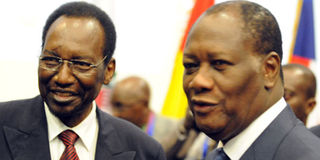
PHOTO | PIUS UTOMI EKPEI Malian Acting President Diocounda Traore (L) chats with Chairman of ECOWAS and Ivorian President Alassane Ouattara during the closing session of the Summit of the Economic Community of West African States (ECOWAS) in Abuja on November 11, 2012. West African leaders at an emergency summit on Sunday agreed on a 3,300-strong force to wrest control of northern Mali from Islamist extremists as fears grow over risks they pose to the region and beyond.
What you need to know:
- Leaders from the 15-nation Economic Community of West African States stressed that dialogue remained the preferred route to resolve the crisis in Mali's north, but said force might be necessary given the extremist threat there
- "We foresee 3,300 soldiers for a timeframe of one year," Ivory Coast President Alassane Ouattara, the current ECOWAS chairman, told journalists after the summit
- Algeria, seen as important to any military operation, has been hesitant to get involved, preferring a negotiated solution
- While not a member of ECOWAS, Algeria is viewed as key due to its superior military capabilities, intelligence services and experience battling Islamist extremism, along with the long border it shares with Mali
ABUJA
West African leaders at an emergency summit on Sunday agreed on a 3,300-strong force to wrest control of northern Mali from Islamist extremists as fears grow over risks they pose to the region and beyond.
The summit in the Nigerian capital Abuja was aimed at setting out a blueprint for military force in Mali's north that would be transferred to the UN Security Council via the African Union. (Read: West African leaders meet on military plan for north Mali)


Leaders from the 15-nation Economic Community of West African States stressed that dialogue remained the preferred route to resolve the crisis in Mali's north, but said force might be necessary given the extremist threat there.
African nations and the international community have expressed growing concern over a continued occupation of Mali's north since it could provide a safe haven to Al Qaeda-linked extremist groups and criminal gangs.
"We foresee 3,300 soldiers for a timeframe of one year," Ivory Coast President Alassane Ouattara, the current ECOWAS chairman, told journalists after the summit.
The troops would come primarily from ECOWAS, but possibly from countries outside the bloc as well, he said.
Discussions also covered the possibility of training of 5,000 Malian troops, according to Ouattara.
Ouattara said he hoped UN Security Council approval could come in late November or early December, allowing the force to be put in place days afterward.
"We have countries that are offering battalions, others companies," he said.
ECOWAS countries he named were Nigeria, Senegal, Niger, Burkina Faso, Ghana and Togo.
From outside of ECOWAS, "Chad could also participate. We have had contacts with other countries -- Mauritania, South Africa."
The summit's final communique stressed that dialogue remained "the preferred option in the resolution of the political crisis in Mali."
"However, regarding the security situation, recourse to force may be indispensable in order to dismantle terrorist and transnational criminal networks that pose a threat to international peace and security," it said.
An ECOWAS source had said earlier that regional military chiefs were proposing a total of 5,500 troops, with some 3,200 from the West African bloc and the rest from elsewhere.
It was not clear whether heads of state had rejected the proposal or if the bloc would continue efforts to reach that level.
Algeria, seen as important to any military operation, has been hesitant to get involved, preferring a negotiated solution.
While not a member of ECOWAS, Algeria is viewed as key due to its superior military capabilities, intelligence services and experience battling Islamist extremism, along with the long border it shares with Mali.
Representatives from countries outside ECOWAS were invited to Sunday's summit, including from Mauritania and Algeria, as well as South Africa and Morocco, which currently hold seats on the UN Security Council. Chad was also represented.
The ECOWAS military strategy was drawn up with the help of experts from the European Union, the African Union, United Nations and the region, which is also seeking logistical support from elsewhere.
Foreign and defence ministers from five European countries -- France, Germany, Italy, Poland and Spain -- are expected to meet next Thursday to discuss a European mission to train Malian troops.
Mali rapidly imploded after a coup in Bamako in March allowed Tuareg desert nomads, who had relaunched a decades-old rebellion for independence, to seize the main towns in the north with the help of Islamist allies.
The secular separatists were quickly sidelined by the Islamists, who had little interest in their aspirations for an independent homeland and set about implementing their version of strict sharia law, meting out punishments including stonings and destroying World Heritage shrines.
Sunday's summit also saw the leaders review the situation in chronically unstable Guinea-Bissau, where a 638-strong west African force has deployed.
It replaced a contingent of Angolan troops whose presence in the country was strongly opposed by the military, prompting an army junta to overthrow the government of Carlos Gomes Junior on April 12.