Breaking News: Old Kijabe dam tragedy: Death toll rises to 45
Cohesion team digs in to defend Nakuru peace deal amid fresh rows
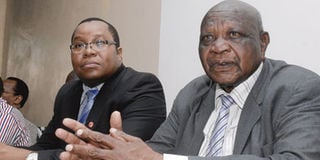
National Cohesion and Integration Commission chairman Mzalendo (left) with former Kanu Nominated MP Wilson Leitich at a Kalenjin community opinion leaders forum at a Nakuru hotel on July 17, 2012 to hammer out the Nakuru County Peace Accord. Photo/FILE
After more than 15 months of work on a peace accord in Nakuru County, it must feel like things are falling apart for Dr Mzalendo Kibunjia and the National Cohesion and Integration Commission.
The commission has poured millions of shillings in working out an agreement it hopes will permanently end ethnic conflicts in the county and serve as a model for other regions.
Nakuru is among 27 counties the National Security Intelligence has flagged as a high potential for violence as elections approach, hence NCIC’s decision to broker the accord.


But just as pen was about to be put to paper tomorrow, some people are emerging to throw a spanner in the works.
Controversy has erupted after a number of MPs, the provincial administration, youth groups and elders claimed that Dr Kibunjia had sidelined them in the talks.
Speaking separately last week, MPs Joseph Kiuna (Molo), Lee Kinyanjui (Nakuru Town), Zakayo Cheruiyot (Kuresoi) and Luka Kigen (Rongai) said Dr Kibunjia’s efforts were headed nowhere as long as he ignored them.
“Who vetted these so-called community elders? Some of them are known war mongers since 1992, and should not pretend to be peace messengers,” Mr Kiuna said.
And Mr Gilbert Kabage, of the Rift Valley Council of Elders, one of the groups claiming to have been sidelined, said the peace efforts will fail.
This quarrel over peace in Nakuru shows how volatile and complex the situation still is in the strategic county, nearly five years after the 2008 election violence.
Dr Kibunjia’s project started with elders of the Kikuyu and Kalenjin before being extended to other communities including the Kisii, Luhya, Luo, Kamba and Somali.
Some attribute the row to the many rival councils of elders, especially among the Kikuyu, who all want to be involved.
But it is the about turn by the provincial administration, which was at the centre of selecting the elders, that is most astounding.
Then there is the matter of competition for elective positions in the coming elections.
Dr Kibunjia has been a champion of communities in mutli-ethnic counties entering pre-election power sharing agreements to minimise the likelihood of marginalised resorting to violence.
Negotiated Democracy
NCIC, he says, is pushing for ‘Negotiated Democracy’. “This is because the voting pattern in Kenya is predominantly ethnic and so communities with large numbers within the counties could easily lock-out the minorities. This is a recipe for conflict,” Dr Kibunjia told the Nation.
In Nakuru, this means Kikuyus and Kalenjins, for example, agreeing to share the senator and governor seats.
This suggestion has wide support within the Kalenjin, but is unpopular among the Kikuyu.
Nakuru has suffered politically-instigated violence every election year since the return of pluralism in 1992 as the two jostled for political and economic power.
Indeed, many thought they had seen the worst until the big one came in 2008. The scars of that violence, that spread from the villages to Nakuru and Naivasha towns for the first time, are still evident.
Some 214 people were killed in Nakuru County, according to a report of the Justice Philip Waki commission which investigated it.
Forty-eight of them were killed in one night of January 26, 2008 in retaliatory attacks in Nakuru town estates.
In Naivasha, at least 22 people were killed in fires set by attackers in January 2008.
The fighting left Nakuru a deeply divided county.
It is no wonder then that NCIC, one of the Agenda Four commissions set up to ensure Kenya never experiences violence again chose Nakuru for its flagship peace project.
NCIC has worked in Nakuru since April last year to come up with the peace accord that is causing controversy now.
For NCIC, although all stakeholders must, ultimately, be brought on board, it is the elders who should be at the centre of the process.
“In the beginning, things were difficult,” Mr Wilson Leitich, the chairman of the Kalenjin elders said. “We could not even sit at the same venue, leave alone in the same room,” he said.
The Kikuyu group, chaired by former banker and businessman Samuel Maigwa, were at Elburgon while the Kalenjin met at the Rift Valley Sports Club in Nakuru town.
With the wisdom of hindsight, it is understandable why the Kikuyu did not want to be in the same room with the likes of Mr Leitich. For them, the name Leitich evokes bitter memories and emotions.
The veteran political operative served as chairman of the Nakuru town council, Kanu branch and Nominated MP in the 1980s and 1990s.
Chop off finger
As the struggle for political pluralism intensified in the early 1990s, Mr Leitich once infamously directed Kanu youths to chop off the fingers of those who flash the two-finger salute, the symbol of multiparty advocates.
Many Kikuyu blame him for the violence that has hit Nakuru ever since that infamous order.
Dr Kibunjia says the reason some of the elders were chosen to participate in the talks was because they had been mentioned in relation to the violence.
Today, Mr Leitich has turned into a peacemaker.
“Some of us elders have played a key role in failing to preach peace and that is why this time around we have decided to put aside our differences as we have realised that fighting will never take us anywhere,” Mr Leitich says.
Reports by Tim Wanyonyi, Muchemi Wachira, Francis Mureithi and Simon Siele