Kibaki’s failing health put on hold all pledges he had made
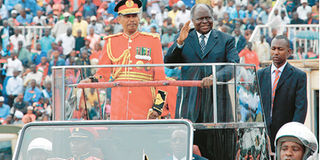
President Kibaki at a past Kenyatta Day celebrations. Journalists who covered the 2002 General Election said that there were two Kibakis: The early Kibaki who was articulate, and the later Kibaki who struggled to maintain a coherent string of thought. Photo/FILE
The first time Kenyans heard of Kibaki’s ill health was an announcement, in late January 2003, that the President had been admitted to Nairobi Hospital to have a blood clot – the after-effect of his car accident – removed from his leg.
Kibaki would continue to carry out his official functions from hospital, his personal doctor, Dan Gikonyo, assured the public, as long as he did not get overstressed.
He suffered from high blood pressure and had been advised, amongst other things, not to wave his arms around. The statement failed to reassure.


‘I don’t want to cause alarm but I am worried about our president’s health,’ a perceptive Kenyan blogger wrote in February, noting that Kibaki had not addressed the nation for a month, remaining silent even when a minister was killed in an air crash. ‘I have this nagging feeling that State House is not telling all.’
Had Kibaki been felled by a stroke? When John Githongo went to visit the Old Man in hospital, he was shocked. Whatever criticisms had been voiced of Kibaki in the past, everyone had agreed on his extraordinary intellectual acuity.
Once Kibaki checked out of hospital, John started briefing him both orally and in writing, so concerned had he become over his boss’s ability to retain information. Journalists who covered NARC’s 2002 election campaign say there have been two Kibakis: the early Kibaki, engaged, focused, acute; and the later Kibaki, vague, distracted, struggling to maintain a coherent chain of thought.
The British high commissioner, Edward Clay, immediately noticed a change. Just as Britain, traditionally a major donor, was hoping to re-engage with Kenya, it became impossible to win an audience with the President. Development minister Clare Short left the country without seeing the head of state.
And Clay noticed that Kibaki struggled during his regular meetings with the diplomatic corps. ‘He had a genuine problem carrying on a train of thought from one meeting to another, particularly if there wasn’t a witness. Some days were better than others. I didn’t think he was himself again until early 2004.’
It was noticeable that when Kibaki was delivering a speech he no longer extemporised or made eye contact with his public, keeping his eyes glued to the autocue.
At an investors’ meeting I attended in London two and a half years after his collapse, by which time many were remarking on the extent of his recovery, Kibaki still gave the impression – characteristic of stroke victims – of being a little tipsy.
His delivery was slightly slurred, his enunciation ponderous, and when answering questions he meandered and contradicted himself. The entire audience seemed to be willing him on, praying he would make it through to the end without some monstrous faux pas.
Confronted by a calamity no one had anticipated so early on, Kibaki’s closest aides reeled and then rallied. If the Old Man was temporarily incapacitated, then they would have to run the country until he regained his faculties, just as the Kremlin’s stalwarts had done whenever their geriatric Soviet leaders turned senile.
The kernel of this group consisted of Chris Murungaru, the burly former pharmacist appointed minister for Internal Security; David Mwiraria, Finance minister and Kibaki’s longtime confidant; Kiraitu Murungi, Justice minister; State House comptroller Matere Keriri; and personal assistant Alfred Getonga.
The one factor all these players had in common was their ethnicity – they were all either Kikuyu, like Kibaki, or members of the closely related Embu and Meru tribes, who the Kikuyu regard as cousins. In naming his Cabinet, Kibaki had presented himself as a leader of national unity, careful to distribute all but the key ministries across the ethnic spectrum.
The popular press, noticing the trend, soon coined a phrase for this circle, the real power behind the throne. ‘The Mount Kenya Mafia’, it called them, a reference to the mountain that dominates Central Province. The phrase was to prove more apposite than anyone could have guessed at the time.
The group’s influence was swiftly felt in a vital area. A new constitution had been one of the key promises NARC had made to an electorate exasperated at the way in which Kenya’s colonial-era document had been repeatedly amended to place ever greater power in the President’s hands.
Kibaki had also, it emerged, secretly signed a memorandum of understanding with his NARC partners promising, amongst other things, that Raila Odinga would be given the post of executive prime minister under a future dispensation.
But now, with Kibaki looking like the weak old man he was, all promises were off. The Mount Kenya Mafia felt too vulnerable for magnanimity. The very same men who had, as members of the opposition, tirelessly denounced a document that skewed the playing field in Moi’s favour, suddenly found there was much to be said for this tilted arrangement.
A national conference convened to hammer out the modern arrangement Kenya needed ground to a halt, as Kibaki’s key ministers proposed changes that would, if anything, concentrate even more power in their man’s hands. The Kibaki delegation would eventually storm out of the talks at the Bomas of Kenya and unveil a draft constitution which bore little relation to what had originally been proposed.
No sooner had the Mount Kenya Mafia climbed the ladder than they were kicking frantically away at it to ensure no one came up behind.
In State House, the process of ethnic polarisation was palpable. Since starting his new job, John had made a conscious effort during working hours to use Kiswahili – the national language – not Gikuyu, as would feel natural with tribal kinsmen. He knew how easily non-Kikuyu colleagues could be made to feel boxed out.
Some of the Mount Kenya Mafia showed no such restraint, finding his self-discipline quaintly amusing. ‘We know you have a problem with this, John,’ they would laugh, lapsing into a throaty barrage of Gikuyu. John would shake his head at the message conveyed. ‘I used to warn them: “This talk will fix us”.
He noticed how mono-ethnic State House had become. ‘When meetings took place, they would all be people from the same area. All the key jobs were held by home boys.’ The old tribal rivalry had returned – or rather, John realised, it had never actually gone away.
At a formal dinner in London several years later, I found myself discussing with John and a British peer of the realm, in light-hearted vein, what were the little signs that betrayed the fact that once reformist African governments had lost their way.
‘My measure is the time a person who’s agreed to an appointment keeps you waiting,’ said the Lord. ‘If it’s half an hour or under, things are still on track; more than half an hour and the place is in trouble.’
I quoted a journalist friend who maintained that the give-away was the moment a president added an extra segment to his name – ‘Yoweri Kaguta Museveni’ ‘Daniel Torotich arap Moi’ – but added that I regarded the size of the presidential motorcade as the tell-tale indication that the rot had set in.
John had been silent till then. Now he suddenly spoke up. ‘How about the time it takes for the man in charge to get a gold Rolex?’ ‘But surely Kibaki already had a gold Rolex?’ I asked, surprised.
‘Yes, but this was a brand-new one. Very slim, with a black face and diamonds round the edge. It was so new it hadn’t yet been measured to size, and it dangled off his wrist. That’s why I noticed it, because it didn’t fit.’
‘So, then, how long did it take?’ ‘Just three months,’ John said, with a grim shake of the head. ‘Just three months.’