Ex-soldiers confess role in Kenya poll chaos
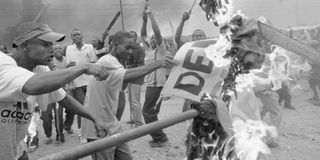
Scenes of the chaos that characterised the 2007/8 post-election period. Photo/FILE
New evidence on how Kenya’s post-election violence was planned, funded and executed has been revealed.
The International Criminal Court says the fresh information was supplied by former soldiers who trained youths who caused the mayhem in various parts of the country.
The witnesses had not given their testimony to the Waki commission which investigated the violence for fear of their security. But they had spoken out after being assured that the court with its seat in The Hague would protect them.


The revelation by an official conversant with ICC investigations came as it emerged that the court would carry out a publicity campaign to ensure Kenyans fully understood its mission.
The official also revealed that ICC Prosecutor Luis Moreno-Ocampo would visit Kenya early next month and head to areas which were hardest-hit by the 2008 violence in which 1,133 people were killed and over 650,000 ejected from their homes in two months of violence that followed the disputed 2007 presidential election.
Among the areas he will visit are Eldoret, Naivasha and Nairobi. President Kibaki of the Party of National Unity was declared the winner but his challenger, Mr Raila Odinga of the Orange Democratic Party disputed the results saying the election had been stolen.
The violence ended after the two signed a peace accord brokered by former UN secretary-general Kofi Annan in which the two agreed to share power with Mr Kibaki as President and Mr Odinga as Prime Minister.
On Sunday, the official working closely with The Hague on the investigations said more key witnesses who had agreed to co-operate with Mr Moreno-Ocampo included chiefs and their assistants from areas affected by the violence.
“The chiefs and their assistants were used in raising and distributing funds to the militias mostly in Rift Valley,” said the official who did not want to be named because of the sensitivity of the matter.
“The information provided by the new witnesses is crucial in nailing the masterminds of the violence and giving ICC the crucial evidence it needs to prosecute the culprits,” he said.
The Waki Commission report revealed that guns from Mt Elgon and an employee of the Eldoret bullet factory assisted the gangs who unleashed violence in the North Rift. The report, which laid bare an intricate plan, design and execution of the violence showed that supporters of a political party were planning to raid Ngano factory — the bullet makers — to steal ammunition.
They were also to seek the assistance of military personnel guarding the factory to train the youths on how to use the munitions. “Later on 4 January, (NSIS) identified an employee of the bullet factory in Eldoret as the leader of youth groups involved in the violence there, further claiming that they shared a password to be used to mobilise them for attack,” the Waki report said.
On Sunday, the official said six post-election violence witnesses had been taken abroad under the witness protection programme while six others were in safe houses locally and were just waiting to be taken out of the country.
The Hague has signalled its determination to carry out intensive investigations and conclude them by the end of the year. Last Friday, the government signed an agreement that allows the court to set up an office to coordinate its activities with its staff enjoying the privileges and immunity enjoyed by diplomats.
The deal also included victim and witness protection and logistical support for ICC operations. The court’s registrar, Ms Silvana Arbia, said she trusted that the government would fully respect its obligations under the Rome Statute and facilitate the work of the court.
The Hague has the backing of the international community which wants to ensure that prominent politicians and business people who planned, financed and helped to execute the post-election violence are arrested and brought to justice.
Mr Moreno-Ocampo was in the country in May for a preliminary visit with post-election violence victims from different parts of the country, suspected perpetrators, witnesses and government officials.
Reports of threats against potential witnesses have been on the increase with the Kenya National Commission on Human Rights warning that the ICC may not succeed in its mission unless the witnesses were given protection.
Last week, Ms Arbia said the ICC had received close to 400 applications from people who are willing to give evidence on the violence.
Mr Moreno-Ocampo has given clear indication that he will pursue two sets of crimes and in each prosecute two to three suspects: those that were committed by sponsored militias and other gangs; and those committed by state agencies.