Next elections a make or break for Kenya, warns Annan panel

Suleiman Mbatiah | NATION
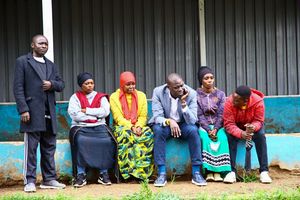
Women at the Pipeline IDP Camp in Nakuru pray on Wednesday, during a visit by well-wishers from various African countries concerned with the deplorable conditions under which they live. Dr Kofi Annan cautioned that the IDPs’ continued presence is hampering reconciliation and reforms ahead of the next General Election.
What you need to know:
- Kenyans told to prepare for radical changes the new Constitution brings into their lives, manners, habits, governance systems and ways of delivering justice
When it opened on Monday, the meeting on reforms progress in Kenya led by former UN secretary-general Kofi Annan, seemed to follow the script of the first two sessions — all talk, cautions, complaints and buck passing.
This was until Mr Annan, who midwifed the country’s grand coalition government, and retired South African Judge Johan Kriegler spoke the words that could be ringing, for the next 14 months, in the ears of President Kibaki, Prime Minister Raila Odinga, fellow politicians and the Independent Electoral and Boundaries Commission.
For Mr Annan, the next General Election would be the most complex ever undertaken in the country, and for Mr Kriegler who led an investigation into what went wrong with the December 2007 elections, the 2012 polls would be a make or break for Kenya.

Quite insightful comments you would say; a kind of reality check for those in government who have been going around the country assuring the public that all will be well come December 17, 2012 — since it appears that would be the date when Kenyans will go to polling stations to elect their next team of leaders.
That the Third Kenya National Dialogue and Reconciliation (KNDR) meeting since the formation of the coalition government chose themes of living by the Constitution, One Kenya One people, integrity of the electoral process, and developing enduring institutions, was very telling.
Having promulgated a new Constitution, Kenyans must be prepared for the hard work of ensuring that the radical changes it brings into their lives, manners, habits, systems of governance, ways of delivering justice, and all array of human rights it bestows on them are met, they said.
An enormous task, you can say.
And there, in the Plenary Hall at the Crowne Plaza Hotel in Nairobi’s Upper Hill, a diversity of Kenyans from politicians, policy makers in ministries and government departments, professionals, heads of commissions, civil society, councils of elders and the media dedicated two days on how the Constitution can be used to conduct the next elections peacefully, and along the course, create enduring institutions that will stop Kenya from going down the abyss as it did in early 2008.
From the speeches of Prime Minister Raila Odinga, Vice President Kalonzo Musyoka, National Assembly Speaker Kenneth Marende, panelists who included Cabinet ministers George Saitoti, James Orengo and Gichugu MP Martha Karua, it is clear that some work has been accomplished — yet much more needs to be done.
However, it was the contributions of participants that told the whole story — that ordinary Kenyans are optimistic about the future but very realistic about the challenges ahead.
So a few questions beg to be asked about the next elections. Why are Kenyans optimistic about the future? And how come they are realistic about the challenges? What are these challenges?
Let’s begin with the reforms which the grand coalition government was to enact. After the basics of ending violence, humanitarian assistance and sharing political power, the hard job of laying the foundation for the subsequent elections started.
So far, so good.
Cases of key individuals suspected to have planned, funded and executed the post- election violence are at The Hague; a new IEBC has been formed; the Judiciary has been reformed; public appointments are made competitively; reconciliation efforts are on; and key legislation to bring the Constitution into force have been enacted.
These steps, in spite of the slow pace of resettling internally displaced persons, have inspired a feeling of optimism among Kenyans. That if the script, as written in the National Accord and the Constitution are followed to the letter and in spirit, there will be no going back to the dark days.
The institutions which have come into existence, thanks to the Constitution, offer hope, caressing the egos of hitherto cynics and cajoling the faint hearted that a better future lies ahead.
Yet at the same time, a few things come up in their minds, reminding them that the situation could easily spiral into a chasm.
Some examples could suffice.
There are no concrete steps towards establishing county governments caused by the disagreement between the Treasury and the Local Government over the financial and economic independence of the devolved units.
The national government appears determined to have control of counties by current regional commissioners to county coordinators, in the process denying governors a role in the security matters and maintenance of law and order in their jurisdictions.
This disagreement prompted Mr Annan to say: “It is vital that the devolution process must be managed properly. Planning must begin now to ensure that the legislative and administrative frameworks are in place to enable a seamless transition to the new governance arrangements. County governments should not, and cannot, begin in a vacuum.”
Secondly, already a government Bill to amend the Constitution to switch the elections date from the second Tuesday in August of every fifth year from the last elections to the third Monday in December has gone through the First Reading in Parliament.
This is compounded by attempts by reports that Ndaragwa MP Jeremiah Kioni is planning to move a motion to scrap the second chamber of Parliament — the Senate — from the Constitution.
What it means here is that one cannot be too sure that all provisions in the Constitution, new laws and institutions that are to be established will, indeed, be given room by the political class.
Justice Willy Mutunga appeared to have captured the caution that is being taken by Kenyans in his speech when he said: “It is becoming clear that there is no clear appreciation of the Constitution, some by default and some by design. There are Kenyans at all levels who are yet to undergo a mental shift to make them live by the new Constitution.”
Perhaps aware of the manipulations that can be put in place to reverse the gains, Mr Annan was categorical that Kenyans have moved on, are more aware of their rights and will not let politicians spoil the soup when it is about to boil.
“The Kenyan people have moved on, they are more aware of their political rights and I am sure it will not be business as usual for politicians,” he said.
Peaceful elections
For Kenyans to have peaceful elections, it would require that sufficient reforms, touching on the electoral process, political party supervision, security and regulations are passed.
In spite of the cloud hanging over the elections, Mr Annan insisted: “Preparation for the next polls must go on. The IEBC must be ready when the date is announced.”
A change in the way of doing things by our politicians will also work with each knowing that competition could be between political parties and individuals but not to the extent of generating vitriol and hatred.
It would also require unifying Kenyans who were torn apart by the chaotic events of early 2008; a pointer that the Truth, Justice and Reconciliation Commission should hasten its work.
Former Tanzania President Benjamin Mkapa spoke of the essence of unity in diversity and multi-ethnicity.
Devolution should be handled with haste and care, ensuring that power is reduced from the central government to counties in line with laws that clearly spell the space of the devolved units.
“The challenge of the coming months is consolidating the constitution, building bridges across ethnic cleavages, patriotism and the drive to hold fair and free elections. That is when what has been said here can be achieved,” said Mr Mkapa.