The genesis of Moi’s ruthless campaign against opponents
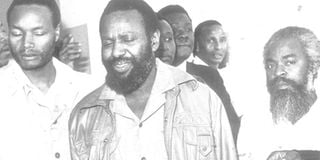
Photo | FILE | NATION
George Anyona is led to court to answer charges of sedition. With him is Njeru Kathangu (left).
In exactly a month’s time the nation will mark the 30th anniversary of the 1982 coup, a watershed moment which is said to have paved the way for a steep descent into authoritarianism during the Moi presidency and triggered the ultimately successful campaign for a new constitution.
Popular opinion has it that Mr Moi was a soft and kindly politician when he came to power and that he only unleashed a crackdown against his opponents in the wake of the attempted coup.
But a review of media articles in the months before the August 1 attempt shows Mr Moi had already launched an extensive campaign of intimidation of the regime’s opponents — detaining lawyers and lecturers, issuing warnings against any attempts to form rival political parties and pushing through the amendment to the constitution which made Kenya officially a one-party state.


Those moves set the stage for the fight for greater political space in the country which reached its climactic moment with the adoption of a new set of laws on August 27, 2010.
The long struggle for that constitution — and how to safeguard the gains it offers — is the subject of a forthcoming book by the veteran journalist Salim Lone.
Mr Lone had a front-row seat through much of the period when Kenyans were fighting for democratic change as a prominent journalist — and later communications consultant — who was close to many of the figures that spearheaded the fight for expanded political space in the country.
His book will primarily focus on the period between 2002 and the next election and will examine the question of how to achieve enduring democratic reform in a country which has not suffered the dramatic upheavals that triggered change in many other African countries.
Mr Lone says it is vital for Kenyans to understand their history to appreciate how far the nation has come and why it is vital to secure the achievements represented by the new Constitution.
“We are going into the next election with more than 40 parties set to field candidates. That was unthinkable only 30 years ago. It was something that was achieved at great cost and people should not take this expanded political space for granted.”
Mr Lone points to Madaraka Day in 1982 — and not the coup which occurred three months later — as the true turning point in the early Moi years.
He says the political environment in the early months of 1982 was characterised by great tension and a sense that the Moi presidency was taking a turn to outright dictatorship.
“We had been meeting for some time to plan the formation of a new party, the African Socialist Alliance. The weekend before Madaraka Day we met at my house with Jaramogi Oginga Odinga, George Anyona and a few others.
“Anyona spent the night at home and I remember he talked freely to Chelagat Mutai on the phone and told her we were forming a party. I had warned him that my phone was tapped but Anyona was a very brash and confident guy and he was not worried at all.”
Two days after that meeting during his Madaraka Day address to the nation, President Moi delivered a chilling message to all the actors that were agitating for the formation of an alternative party to challenge Kanu.
A look at the Daily Nation front page articles in the two weeks from June 1, 1982 offer a glimpse of the crackdown by the state which entrenched dictatorship in the country and fed the struggle for change.
That struggle’s first major achievement was the introduction of multi-party democracy 10 years later.
The report on the Madaraka Day ceremony records Moi warning that there were “self-styled revolutionaries” who wanted to disturb the peace by importing “foreign ideologies.”
He said some politicians had plans to incite public service workers to go on strike but warned that they would soon be arrested.
“At one point,” the main story in the Nation edition of June 2, 1982 records, “the President turned to Police Commissioner Ben Gethi and asked: ‘Wapi commissioner?’ Mr Gethi stood up and saluted. ‘Do your duty,’ the President ordered.”
That single pronouncement was the opening bell for a wave of detentions of lecturers, student leaders, politicians, lawyers, journalists and others suspected of supporting the cause of an expanded political space.
The detentions started the very next day after Madaraka Day, as reported on the front page of the Nation on June 3, 1982.
“Anyona Detained,” was the headline. The article said Mr Anyona, one of the first agitators for changes in the political system in the country, had been arrested under the Preservation of Public Security Act.
Judge S.K. Sachdeva dismissed a plea by Mrs Esther Mokeira Anyona asking for her husband to be produced in court. The reporter recorded that Justice Sachdeva “criticised the practice by some people of rushing to court without ascertaining the facts”.
The man who defended the state in that case was the Deputy Public Prosecutor, Sharad Rao. He dismissed the complaints by Mr Anyona’s lawyer, John Khaminwa, that his client had been held for too long before being charged.
“I am not aware of any rule which says holding a person in custody for more than 24 hours is illegal,” said Mr Rao, who now heads the panel vetting judges and magistrates as part of the cleanup of the judiciary recommended by the new constitution.
Mr Khaminwa’s request for the Attorney-General and the Criminal Investigations Department (CID) chief to be compelled to produce Mr Anyona in court was dismissed.
The headline of the following day’s newspaper, June 4, shows how ruthless the state’s approach was getting.
“Khaminwa picked up by police,” it recorded, saying Mr Anyona’s lawyer had been detained alongside another pro-change campaigner, the Kenyatta University lecturer, Maina wa Kinyatti.
Mrs Khaminwa’s wife, Joyce, who was a partner in the couple’s law firm, said the police had searched their offices and perused the file relating to Mr Anyona and another relating to the case of former deputy director of intelligence Stephen Mureithi, who had also been detained.
She followed the policemen who arrested her husband and said the car ended up at the CID headquarters. His detention was formally announced in the June 5 editions of the newspapers, with Mr Rao stating that Mr Khaminwa had been served with detention orders.
Two smaller stories on the front pages announcing the detentions offer an additional peek into the oppression that had taken hold in the country.
In one, on June 3, President Moi signalled a move to control dissent at the University of Nairobi which was the hotbed of activism led by such figures as the writer Prof Ngugi wa Thiong’o and university staff union leaders such as Dr Willy Mutunga.
“Anti-Nyayo students will not be admitted to the University of Nairobi,” the article reported.
“President Moi said students vying for admission will be seriously screened to determine their Nyayoism before they are offered places, he added, expressing concern over the deteriorating discipline at the university.
“He asked the true Nyayo followers at the university to convene a Kamukunji so as to identify themselves as separate from the dissidents. Such a meeting would enable the government to know who were Nyayo and who were ‘wolves in sheepskin’.”
More ominous was the second story on the front page on Friday, June 4. “One-party state Bills are published,” it reported.
The Bills, the Constitution of Kenya (Amendment) Bill, 1982 and the Election Laws Amendment Bill, 1982, included the famous Section 2A line: “There shall be in Kenya only one political party, the Kenya African National Union.”
Before those Bills could be brought to the House, President Moi set the stage for more arrests of lecturers when he told a rally in Nakuru that there was a plot to import arms to destabilise the country.
He said lecturers had procured “Maasai Simis” and other weapons, which were to be supplied to students to cause instability.
Mr Moi claimed that there were six lecturers who were teaching “nothing but the politics of subversion through textbooks majoring on violence.”
He said Africans had lived from time immemorial under one-party systems, citing the example of councils of elders among various communities.
A few days later, Prof Kinyatti was charged with being in possession of “seditious material”. His arraignment in court was followed two days later by the arrest of two other lecturers, Mr Kamoji K. Wachira and Mr Al Amin Mazrui.
On June 10 Dr George Mkangi and Dr Mutunga were picked up from the University of Nairobi with their colleague Mukaru Ng’ang’a following them into detention a few days later.
As they were being locked up, the Moi state was consolidating its hold on power through legislation which banned political competition to Kanu.
“One-party State: It’s now official” was the headline on the edition of Thursday, June 10, which noted that the amendment which was proposed by Attorney-General Charles Njonjo and seconded by Vice-President Mwai Kibaki had received 158 votes for the bill and none against.
Mr Lone says he will highlight some of the lessons from this period although his book will primarily focus on events in the last decade and how recent democratic gains can be consolidated.
“If there is a goal for the book it is to examine the subject of how to bring about progressive change in a country where you have not had some profound, life-changing crisis or revolution.
“In Uganda you had the Museveni guerrilla movement, in South Africa you had the end of Apartheid. Kenya has not had something on that scale yet the people still yearn for progress and change.
“How do you get those with the political power and wealth to embrace the need for change? You have to show them that their interests lie in a more progressive and stable nation underpinned by good laws. Consensus is one of the key issues.”
Non-partisan
Mr Lone, who served as Mr Odinga’s media consultant during the last elections, says his approach will be strictly non-partisan. The book will be published soon after the next elections – and not before – to allay fears of a political motive.
“This country works best when all the major players are striving to achieve the same goal. I drew great satisfaction working on the ‘Yes’ campaign because I was invited to take part jointly by Kiraitu Murungi and Anyang’ Nyong’o.”
Mr Lone, who hopes to interview leaders from across the political divide for the book, says it is vital that Kenyans learn lessons from recent history and establish the foundation for durable change.
“The endorsement of a new constitution was a wonderful achievement and we must consolidate the benefits and not allow ourselves to go back where we are coming from.
“We must tackle the cancer of corruption and tribalism even in some of our most important institutions such as parliament. Absolutely key is that we must have a clean, credible, free and fair election.
“If things go wrong it will be a massive setback. People will give up. If the election goes smoothly, it will serve as the platform to build towards a path of great success.”