King Mumia’s plan to reclaim past glory of Wanga Kingdom
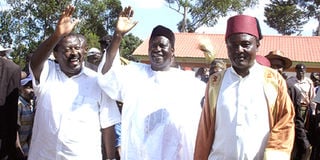
Prime Minister Raila Odinga (centre) and his deputy Musalia Mudavadi wave to the public accompanied by King Peter Mumia the second (right) after launching Nabongo Cultural Centre at Eshiembekho in Matungu constituency. PHOTO JACOB OWITI
What you need to know:
- A people struggle to retain identity as others succumb to Western culture
Tucked away among plantations of sugarcane, the Wanga community has struggled to retain its identity as other kingdoms wither from the onslaught of Western culture.
And two weeks ago, the community celebrated a milestone in the old kingdom.
It was the opening of the Nabongo Cultural Centre and shrine in Matungu constituency, Western Province, where the community’s cultural artefacts and age-old habits have been preserved.


It could be the latest addition to the growing tourist sites in Kenya’s western tourism. It was an occasion few wished to miss, and some trekked long distances to the newly constructed centre on the outskirts of Mumias Town to witness its official opening.
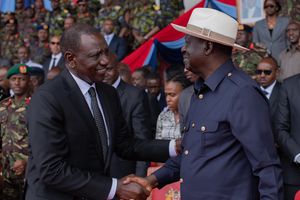
In attendance were Nabongo Peter Mumia II, Prime Minister Raila Odinga, Deputy Prime Minister Musalia Mudavadi, and ministers James Orengo, Fred Gumo, Oburu Oginga and Alfred Khangati. Others were MPs Eugene Wamalwa, Ben Washiali, Alfred Odhiambo and National Heritage permanent secretary Jacob ole Miaron.
Traditional greeting
When he took to the podium, Nabongo Mumia II hollered “Kualulukha! Kualulukha!” and the crowd, familiar with the traditional greeting responded in unison “kulama”, which means a tree will survive even when it shades off leaves.
As he bellowed those words, Nabongo wanted to reassure the community entrusted under his guidance by the ancestors that the once vibrant Wanga Kingdom that dates back to 1,000 years would remain strong.
Nabongo cultural centre was the brainchild of Nabongo Mumia II to help conserve traditional artefacts and history. At the centre, visitors will see these great pieces of art and culture in a museum and a library.
Within the compound is a prototype traditional Luhya homestead, complete with huts for the man of the house, the wives and sons. This is where the PM’s entourage sipped traditional brew using long straws.
Besides, there is a mausoleum where the past Kings (Nabongo) were interred. The Wanga king gestured at the mausoleum opposite the traditional homestead, saying: “There is the place where Nabongo Wanga, Nabongo Mumia I and Nabongo Netia lie.”
Next to the past Nabongos’ graves is a space where the current King could be laid to rest some day.
The entire work is envisaged to cost Sh46 million, with Mumias Sugar Company contributing Sh12 million towards the project through its corporate social responsibility. The Government has largely funded the remaining part.
The work is not yet complete.
“We want to have a multi-purpose hall, an eco-tourism cultural village, botanical garden, residential wing, and tourism van and sports field,” said Nabongo.
Despite the elaborate celebrations to welcome the cultural centre, Nabongo Mumia II has reservations — fear that his ancestors’ kingdom is fading away at a worrying rate.
With the collapse of many kingdoms, Mumia says the society has very little, if anything, to be proud of in the 21st century.
Many future generations risk getting lost, culturally, he told the crowd.
Nabongo Mumia II asked the Government to embrace “our traditions and acknowledge traditional leaders, whose contribution towards integrated Kenya cannot be forgotten just like that.”
He asked the PM to ensure the envisaged new constitution recognises traditional leaders.
“When successive governments overlooked the traditional settings, Western culture slowly slithered in, eroding gains we had made for over 1,000 years down the line,” said Mumia.
Since taking the throne as Nabongo in 1974, Mumia’s quest to reclaim the celebrated Wanga Kingdom has not yielded much due to lack of government support.
The kingdom dates back to 1050AD with the birth of Nabongo Wanga to King Mwanga III. The Nabongo Wanga settled in Lela in Nyanza Province from Uganda.
He later moved to Imanga in Mumias District, where he was taken in by area chief Muima as a herdsman.
The chief’s wife saw a rare ring (omukasa) with Wanga, which meant he was a prince, and informed the chief, who later sent him away.
But he settled in the nearby village and ousted the chief. Nabongo Wanga later moved to Matungu around 1100 century and died in 1140AD.
Nabongo Mumia I went down in history as the most successful leader of the kingdom. Born in 1849, he succeeded his father Nabongo Shiundu in 1880.
“He was a brave, shrewd and intelligent king and ruled with supreme authority,” says Nabongo Mumia II.
He was the king, chief justice, commander-in-chief and final appeal authority at all civil and criminal cases in the vast kingdom traversing Western region to Naivasha and all the way to Jinja, Uganda.
He had chiefs from Jinja to Luo Nyanza. Chief Chabasinga took care of Busoga Jinja; Lenana Talai represented him among the Maasai while chief Odera Akang’o was in charge of Luo Nyanza.
“He became so popular that whites like Joseph Thompson and Bishop Hannington visited between 1883 and 1889 and sought his guidance through to Uganda,” says Nabongo Mumia II.
Indeed, the remains of Bishop Hannington, who was killed in Uganda days after meeting Nabongo Mumia I, were taken to Mumias, where he was buried. The grave is at the periphery of a football pitch.
The British acknowledged Mumia’s authority and on June 30, 1913 L. G. Bowring, the deputy governor gazetted his appointment as paramount chief of North Kavirondo District, Nyanza Province.
“All headmen and councils of elders in the North Kavirondo district are subordinate to him,” reads the gazette that regularised this appointment.
But Nabongo Mumia I was retired in 1926, a move he opposed, and refused to take a Sh250 monthly pension in exchange until the colonial masters threatened to arrest him.
He died in 1949 to be succeeded by his son Nabongo Shitawa who was not as powerful.
Mumias Town was named after him. Previously, the town was called Lureko.
Prime Minister Odinga assured him that the Government would ensure various cultures prosper and urged citizens to adopt progressive cultures and stand out as distinct people in the world.