How loyalty cards make you a bigger spender
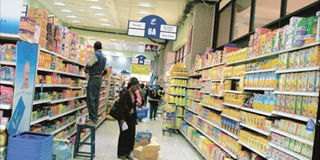
Shoppers are unaware that when their cards are swiped at the till to award them points, their spending profiles are taken and used for marketing. Photo/ WILLIAM OERI
What you need to know:
- Supermarkets have more than a few tricks in pushing high-margin products.
- Smart card is giving supermarkets and other shopping outlets important information.
Forbes magazine recently reported that a retail chain put all its checkout counter data into a giant digital warehouse and set the disk drives spinning.
What popped out was a most unexpected correlation: sales of diapers and beer. Young fathers, it showed, would make a late-night run to the store to pick up pampers and get some Bud Light while they were there.
The magazine says the store, capitalising on the discovery, placed these disparate items together — and sales zoomed. Businesses have got tonnes of transactions data which, if they analyse, would give wonderful insights into shopping trends and customer preferences.


The supermarkets have more than a few tricks in pushing high-margin products. The one that irks the most is spreading products out across a wall so you have to search to find what you want.
Meanwhile, the products they want you to buy are smack in front of your face. Did you know that every time you buy something your shopping habits are tracked? Then what comes out is a report on what you like about as you shop.
Your smart card, or signing to loyalty schemes, is giving supermarkets and other shopping outlets that important information.
It sounds good — loyalty cards entitle us to freebies or cash simply for shopping. Of course, retailers get something in return: a heap of information about us we might prefer them not to know. That’s before they get started on the new tags that track you and what you buy.
Last week someone received a call from one of the banks in the country enticing him buy into their products. But one critical question is, where do banks get these contacts?
It has been said that smart cards are an avenue through which this information can be accessed. This idea is driving many banks to sign up agreements with retail chains so they can be able to accesses such information.
Every time you reach the checkout in bigger supermarket chains, it’s the same question: do you have a smart card? It can get irritating, but nonetheless we have willingly signed up to their reward schemes in droves.
Many have accepted the membership rules of these innocent-looking, points-mean-prizes clubs: you show us some loyalty, say the retailers, and we will give you nice bonuses in return.
The Chartered Institute of Marketing Kenya branch chairman Andrew Mutuma says loyalty, on the face of it, is based on how much you spend with one particular retailer. Besides, in Kenya we love bargains, and getting something for nothing even more.
But the question is: how much does the nothing really cost? It is not simply a matter of choosing to be “loyal”, now synonymous with “open your wallet”, to one supermarket over another — the cost is in having your purchases scrutinised and analysed in staggering detail by the loyalty card retailers.
“You’d be surprised what they can do with a seemingly innocent flow of till receipts, coupled with your loyalty card.
Having accepted the principles of these schemes, we have paved the way for the kind of surveillance technology that will turn your stomach once you realise that it is happening in real time and not in some implausible, futuristic film,” Mr Mutuma says.
More fool them, you might think, as you cash in points to redeem all manner of tempting handouts. There is no catch or con to the mechanics of loyalty reward schemes.
Nakumatt, for example, gives you a point worth Sh2 for every Sh100 you spend, which you receive once you hit some considerable points.
On the surface, loyalty cards get you to increase — or “consolidate”, as the marketing people say — your spend in one store. Given the choice between two stores, we are more likely to shop at the one where we earn rewards.
Behind this visible profit benefit lies the genius purpose of these schemes. Then retailers have found a way to scrutinise the shopper – not as a generic mass but as an individual.
Consider the detailed information that every loyalty card user volunteers to the store. Mr Mutuma says each swipe of the card sends your spend — what you bought, where and how you paid for it — into a databank profile of your purchase history, along with the personal information you gave when you signed up for the card.
Some, their application form will have asked you for your employment status, number of children, spectacles or contact lens usage and, if you are pregnant, when your baby is due.
Others, meanwhile, ask how many people live in your house, the ages of those under 18, the number of cars you have and your total household mileage. With such information on your spending behaviour other businesses are getting such information to target you for their products.
Now we have a busy industry of data-miners looking at your profile to glean specific observations on how you like to buy. Loyalty card users enjoy discounted prices, special coupon offers, and rebates or “points” towards shopping sprees, much like credit cards.
Many users consider the idea of targeted marketing a boon — if they like one kind of product, why wouldn’t they want to get offers for similar products?
Details of loyalty points and the point-gaining transactions are being captured by a stand-alone card terminal and transferred to a PC or a back-end server for further analysis.
The loyalty software maintains a complete database of all customer rewards and reward suppliers.
It’s not an unreasonable concern that customers’ buying profiles will be as vulnerable to fraud and misuse as their credit card numbers, particularly if the third-party companies practice lax security measures.
The Kenya Alliance of Resident Associations CEO Stephen Mutoro says that the proliferation of such schemes not only by supermarkets but also other shopping outlets should be investigated.
“The right to privacy must be observed. When they disclose their customers’ profile to a third-party that puts their security at risk,” he says.
Mr Mutoro says that to protect consumers, the government must investigate and authenticate such programmes and those found contravening the right to privacy their activities should be revoked.
“This is fraud, when they give my details to other parties they must be getting some privileges from them. This might be a big scandal that they use to make extra cash from the consumers’ ignorance,” he says.
Apart from monitoring your buying behaviour another form that businesses use to boost their profits while building customer loyalty are by the use of loyalty cards.
Marketing experts say that brand loyalty is the biggest driver of sales. Studies show that loyalty cards are one of the most cost effective ways to build brand loyalty and improve customer retention.
Major retail and supermarket chains use loyalty cards as a vital tool to improve profitability, but you don’t need to be a national high street store to run a profitable reward card scheme.
Mr Mutuma says loyalty solutions and the advantages and rewards that they offer help retailers increase frequency of store visits and increase spending while also retaining and encouraging loyalty from existing customers.
Nakumatt has loyalty card known as Cybercash card started in 2001 and was intended to operate as a debit card. It was later re-created in 2003 as a cash discount card under a customers reward programme as a way of rewarding its loyal customers.
A manager with Nakumatt says that shoppers are promised goods for value against points, discounts with service providers, random surprise or birthday, off-peak time double points and redemption of points for cash and gift vouchers.
“During school opening period, we target our customers by allowing them redeem double their points for school fees and shopping. You remember the promotion we had at Nakumatt Junction where we were selling our products half price? We gave our special loyal clients the first priority,” the manager says.
Tuskys has the Magicpay rewards scheme in which consumers redeem accumulated points for shopping. Just like Nakumatt for every Sh100 used, one gets one point which can be redeemed for Sh2. Uchumi has the U Club card and Ukwala too launched its loyalty card recently.
Mobile phone companies have mastered the art of retaining their subscribers by introducing schemes to award loyal customers. A good example is a service by Safaricom known as Bonga Points in which for every Sh50 airtime used one gets 10 points, which can be redeemed when they reach 200 points.
In this scheme a subscriber who has 300 points can redeem four free talking minutes or 12 free SMSes, while for 200 points one is able to get eight free SMS.
Zain has a programme in which its subscribers are able to call for Sh65 the whole day. Family TV members get discounts to shop at some specific outlets.
Reward and Recognition (R&R), a company dealing in loyalty schemes, has an arrangement with Uchumi supermarkets (U Club card), Sarova hotels, Concorde car hire, ToyWorld, DHL, CAT, Acacia Apotheke Two Ltd, BP and Shell where card holders get one point for every Sh100 spent.
R&R says that as a policy no information of customers is shared with third parties but notes that the question of companies tracking consumer shopping behaviour is normal and assists in designing appropriate products.
In a move to attract customers car dealer, Marshalls East Africa, early this year launched a value-added service for its customers. Called the Privilege Club, it is free and customers enjoy fixed price on parts and labour, and diagnosis of mechanical breakdowns.
Managing Director Marshalls East Africa, Nguvi Kitau, said: “Customers will get a card on which they earn points which can be redeemed for any services as discount in any of our branches countrywide.”
Some of the supermarket chains our team spoke to said that apart from rewarding their customers, the loyalty scheme helps them with the pool of information on which they can appropriately target their clients with the best services or products.