The life and times of the bold but reckless Barack Snr
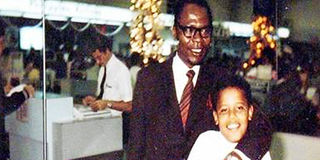
Obama senior with his son, Barack Obama, who is now US President
The crowd at Makadara Hall had been waiting for nearly half an hour. It was a humid Sunday in 1957, and over a thousand men and women were eager to see their political hero, Tom Mboya, take the stage.
Craning for a glimpse of the presumed next president of the Nairobi Peoples Convention Party, the crowd churned against the sheet-metal walls that framed Nairobi’s largest social hall, chanting bits of song, ever watchful of the European police officers stationed at the doorways.
Mboya was often late, but he always showed up at this weekly event, easily one of the city’s most popular political meetings.


Just as the crowd was growing impatient, a figure stepped on the stage. But it was not Mboya in his trademark red windbreaker.
It was a woman. More astonishing, it was a mzungu. She was barely over five feet tall, her floral skirt falling just above her pale ankles, a tentative smile playing across her angular face.
The crowd grew abruptly quiet, uncertain as Mboya appeared on the stage behind her. What did this mean? Surely, this could not bode well.
But when the white woman began to speak, with Mboya acting as her interpreter, they listened. Her name was Elizabeth Mooney. And she had come to change their lives.
The 43-year-old Texas native was a literacy teacher who the Kenyan government had employed under a US-sponsored programme to teach Kenyans how to read and write.
In the four months since she had arrived, Mooney had had difficulty spreading word of her programme. And so when the immensely popular Mboya, an ardent advocate of education, had offered to let her appear on stage, Mooney jumped at the chance.
Impatient crowd
Mooney made good use of her few minutes, explaining to the impatient crowd how easy it could be to learn how to read and write and exactly how her classes were taught.
Although her appearance prompted much fluttering in the US Consulate office and a reprimand in one of the local papers — both parties were distraught at the impropriety of her appearing on stage with such a high-profile politician — her mission had been accomplished.
Her words that day turned the tide in her favour, and the numbers in her classroom tripled the following week. During her two-year stay in Kenya, Mooney would change the course of hundreds of Africans’ lives, but none so completely as that of a young man named Barack Obama.
In a matter of months, Mooney not only helped give focus to his wandering ambition, but at a time when many doors seemed closed to him, she provided the critical assistance that ultimately put him on a plane to America, thus planting the seed of a political upheaval to come a generation later.
They had crossed paths several times in the city, for Obama often attended Mboya’s afternoon addresses. But one afternoon, not long after her appearance at Makadara Hall, Mooney happened to visit the cramped office of the Indian law firm where Obama worked as a clerk typist taking dictation.
This time they began to talk.
Eager to staff her Spartan office on Ribeiro Street in the heart of Nairobi, Mooney observed that Obama was both fast and accurate at the keyboard as he worked. She promptly offered him a position as her secretary, and Obama started work for her a few days later.
Mooney was a colleague of world-renowned literacy expert, Dr Frank C. Laubach of New York, who had recommended her for the Kenyan post and helped to fund the project. After paying Obama for several months out of her office expense fund, she turned to Laubach for the money to pay him on a more regular basis. Mooney was impressed with his performance.
In a letter, she asked for $100 a month “for salary for Barack O’Bama for six months if possible,” she wrote, adding an Irish twist to the spelling of his name.
Laubach agreed. And early in 1959 Mooney wrote to thank him.
“Thank you so much for the secretarial help,” she wrote to Laubach. “Barack is a whiz and types so fast that I have a hard time keeping ahead of him. I think I better bring him along and let him be your secretary in the USA.”
Obama could not have had less in common with his new boss.
Sara Elizabeth Mooney, known as Betty, was the granddaughter of the cofounder of the Texas Christian University in Fort Worth, Texas. Single, she had spent virtually all of her life teaching.
At age 30, she met Laubach, a congregational minister and the father of a global literacy programme known as “Each One, Teach One,” a method by which each new reader teaches another person what they have learned, thus passing on the new skill one person at a time. Inspired by his personal faith in God and messianic zeal, Mooney committed herself to literacy.
For eight years, she worked in India, first running a mission boarding school and then teaching in an adult literacy center.
Before accepting the post in Kenya, she spent two years as the supervisor of a literacy training programme at the Koinonia Foundation in Baltimore, Maryland, at the time a Christian-based training center for literacy workers. Laubach served as president of the board of Koinonia.
Given up on idea of marriage
A straightforward woman with a tight cap of brown curls, Mooney was prone to prim cotton dresses and flat shoes.
A “spinster” in the jargon of the day, family members believed she had long ago given up on the idea of marriage. She was a deeply committed Christian who believed that God had brought her to Kenya on a “literacy safari,” as she described it, to empower people to read. She said devotions daily.
Then there was Obama. He was 21-years old, a racehorse at the gate, already sporting the “academic” look that was in vogue in some Nairobi circles. His jacket was finely cut, his glasses a donnish horn rimmed, and the occasional pipe provided the crowning touch. Never mind that once he put the pipe down he invariably resumed his chronic chain smoking.
On the brink of becoming a father for the first time, he was consumed with a single burning passion, which was to be a player in the development of a newly independent Kenya.
But with a record already marred by rejection from Maseno University and a series of small, short-lived jobs on his résumé, his prospects were moderate at best.
Mboya had urged Kenyans to think practically as they prepared for independence. He wanted them to get training in the fields that would be of service to the country, particularly in areas such as economics and administration.
With his impressive mathematical skills, Obama was convinced his calling was to serve as an economist who could help develop the country’s fiscal foundations and project its needs in the future.
All he needed to do was find some way to get a university degree, possibly even at a college overseas as some of his friends were planning to do.
Mooney was the first person who tried to channel his strengths in such a direction rather than punish him for his audaciousness. That she was a white woman only added intrigue to the relationship.
Literacy campaign
Mooney had been hired to help the Kenya Department of Education set up a pilot literacy programme, funded by the US International Cooperation Administration, then an arm of the US Department of State that administered aid for a host of development purposes.
Her job, for which she was paid $6,355 a year, was to develop a country-wide literacy campaign that would instruct adults how to read and write first in their native language and then in English. The first step was to assemble a skilled administrative staff and launch a series of classes both in Nairobi and in the field.
The need was huge. Eight out of ten African adults in Kenya could neither read nor write, a fact that loomed as a huge impediment to a nation fast approaching independence.
Political implications
Another one of Mooney’s tasks was to produce reading materials and primers written in the tribal languages, such as Dholuo and Masai, that could be used in the classroom.
The Laubach method used a series of familiar pictures coupled with related sound associations to teach words.
Once the student grasped the relationship between the sound and the thing, they could then master syllables and, ultimately, the words.
For the millions of Kenyans who could neither read nor write in the 1950s, the political implications of such a campaign were huge, as Laubach well knew.
“You think it is a pity they cannot read, but the real tragedy is that they have no voice in public affairs, they never vote, they are never represented in any conference, they are the silent victims, the forgotten men,” Laubach wrote in his 1943 book, The Silent Billion Speak.
Mooney launched the Literacy Center in a pair of rooms — No 19 and 20 — in Ribeiro House in the heart of Nairobi. She was soon assisted by another white woman, Helen Roberts, who had left her home in Palo Alto, California, in the summer of 1958 to volunteer as a literacy teacher.
Roberts, a grandmother of eleven and the author of children’s books, had heard Laubach speak and soon learned his method herself. Although Mooney was a skilled manager, Roberts, her senior by more than a decade, was the “people person,” and the two worked well as a team.
They were a curious pair — two middle-aged women navigating the crowded city streets in Roberts’s blue Volkswagen Bug. Undaunted, they soon managed to introduce themselves to an emerging group of Kenyans who had begun to address the country’s dire need for educational opportunities.
Mooney and Roberts also traveled widely “upcountry” to hold teacher training courses and distribute readers.
Although the Laubach method caught on quickly and Mooney’s classrooms were soon packed with adult students, getting started was not easy.
Deep-seated suspicion
In the beginning most Kenyans regarded Mooney with a deep-seated suspicion, wary of anything that hinted of the colonial government’s largesse, one of the legacies of the bloody Mau Mau years.
Although many Kenyans were hungry for education, they were fearful of the government publicity vans and radio announcements that broadcast the programme under the banner “Kusoma Ni Faida,” Swahili for “reading is profitable.”
Most were convinced it was all part of a scheme to raise taxes or move them elsewhere, just as they had been forcibly relocated to the brutal detention camps during the Emergency.
Indeed, Mooney’s appearance in the politically charged atmosphere of the day prompted a flutter of suspicion far beyond the audience at Makadara Hall as well. Days later a columnist for the Sunday Post, a Nairobi weekly newspaper, sniffed at the impropriety of her appeal, writing, “I know that Miss Mooney merely talked about adult literacy but a political platform is not the place for such talk by a representative of a Government department — particularly a representative of a nation who are on record as being against the idea of the Colonies.”
And a week after her address a member of Nairobi’s Criminal Investigation Department dropped by her office to “discuss” her breach of protocol. But Mooney, an earnest law abider, had acquired approval from educational authorities before she made her appearance.
Deeply moved by the plight of those who could not read or write, Mooney was sure that her mission was divinely led. In a letter she wrote several weeks after she arrived, Mooney described watching a group of illiterate women leaving a community hall and heading “over the fresh green hillside to their homes, some of them ten miles away. And at last I felt that my own trail had stopped going in circles and had led me to the reason for being here... I no longer doubt God’s time table. There is some reason for my being here at this particular time.”
Mooney’s efforts attracted the interest of two of Kenya’s most prominent college graduates, who were among a tiny handful of Kenyans who could boast of college degrees. One was Dr Julius Gikonyo Kiano, who had earned a PhD from the University of California at Berkley in 1956 and was the first Kenyan to receive a doctoral degree, and the other was Kariuki Karanja Njiiri, who earned a Master’s of Arts degree from Lincoln University in Pennsylvania. Kiano, a savvy Kikuyu economist, helped Mooney overcome the Kenyan people’s widespread mistrust of government and guided her in the recruitment of teachers. Njiiri, the son of a senior Kikuyu chief who had his pick of jobs on his return in 1959, became her chief assistant. Both men would be instrumental in assisting Tom Mboya to raise money and select candidates for the student airlifts.
One of the names that would come across their desks for consideration would be Barack Obama.
In the crowded Ribeiro Street office, Obama started out as a low-level clerk assigned to basic office tasks. He took dictation, helped organize the office, and assisted with translations in Luo and Swahili. But he was soon promoted to the writing committee, composed of half a dozen young men assigned to write elementary adult readers in their native language.
Dressed in jacket and tie, Obama and the other writers sat at long wooden tables, carefully penning the pamphlets used as follow-up to the literary primers. If the high-arching Obama grumbled that the work was somewhat menial, he also realized that the job was a critical first step toward fulfilling his dream.
First, the work was exceptionally well paying. But more important, teaching literacy was a critical component in the advance toward independence.
In all, Obama wrote three books in Luo that employed “Otieno” the wise man as a model instructor.
The first book was Otieno Jarieko, Kitabu Mokuongo: Yore Mabeyo Mag Rito Ngima, or “Otieno Jarieko, the Wise Man, the First Book: Wise Ways of Health.” Otieno describes a variety of healthy foods, demonstrates how to use a knife and fork, and gives instruction in the proper way to build a latrine.
Wise ways of farming
The second and third books center on Otieno’s teachings of the wise ways of farming and citizenship, respectively. Obama worked on the three books almost the entire year and a half that he assisted Mooney, and he proudly included them on his résumé.
Working closely with the American women and a handful of their Kenyan assistants, Obama kept his bravado under close wraps and toed the line. The style in the office was highly cooperative and the staff represented a host of different tribes, due in part to the need for materials written in varied tribal languages.
To be continued....